
A 1035 exchange is a tax-free carrier-to-carrier transfer of one insurance or annuity contract into another, allowed under Internal Revenue Code Section 1035. The main benefit is simple: your gains stay tax-deferred instead of getting taxed as if you had cashed out. The catch is that the money has to move directly between carriers, and you need to follow ownership and annuitant rules exactly, or the IRS treats it as a taxable event instead.
TL;DR:
- A 1035 exchange only applies to transfers from life insurance to life insurance, annuity to annuity, or certain long-term care combinations; it cannot convert an annuity into life insurance.
- The transfer must occur directly between carriers without the policyholder ever taking possession of the funds, or it will be considered a taxable surrender.
- Processing typically takes two to six weeks, with delays often caused by carrier-to-carrier coordination, signature mismatches, or incomplete documentation.
- Cost basis and surrender charges carry over to the new contract, but misreporting or partial withdrawals within the restricted period can trigger unexpected tax consequences.
- A thorough review before signing is essential to ensure the new contract's fees, surrender schedule, and riders genuinely improve your financial plan, especially for retirement or estate planning needs.
Table of Contents
- What Qualifies for a 1035 Exchange Under IRC §1035
- How the 1035 Exchange Process Actually Works
- IRS Rules and Tax Traps That Catch People Off Guard
- Does a 1035 Exchange Make Sense for Your Retirement Plan?
- Preparing for a 1035 Exchange: What to Gather First
- What Happens to Death Benefits, Dividends, and Riders
- Real-World Scenarios: How a 1035 Exchange Plays Out
- The DG Life Group Perspective on 1035 Exchanges
- Get a 1035 Exchange Reviewed Before You Sign Anything
- Sources
- FAQ
What Qualifies for a 1035 Exchange Under IRC §1035
Not every swap of one contract for another gets tax-free treatment. The statute is specific about which directions are allowed, and getting this wrong is the fastest way to trigger a tax bill you thought you'd avoided.
Permitted exchanges include:
- Life insurance for another life insurance policy
- Life insurance for an annuity contract
- Annuity for another annuity contract
- Endowment contracts for another endowment or an annuity
- A life insurance or annuity contract combined with a qualified long-term care rider or standalone LTC contract, under later expansions to the rule
What doesn't work: swapping an annuity into a life insurance policy. The code runs one direction only. 26 USC 1035 lays out these categories directly, and Treasury Regulation §1.1035-1 adds a critical detail: for annuity-to-annuity exchanges, the same person has to remain the obligee or annuitant on both contracts. Change the owner or annuitant during the swap, and you've disqualified the exchange.
How the 1035 Exchange Process Actually Works
The process runs through the carriers, not through you, and that's the entire point. Here's the sequence in practice:
- Pick the new contract and confirm it fits. Compare features, fees, and the new surrender schedule before you commit to anything.
- Gather your current contract's details. You'll need the contract number, current cash value, cost basis, and any outstanding loans against the policy.
- Complete the receiving carrier's 1035 exchange form. Sign it exactly as your name appears on the original contract. A mismatch here is one of the most common reasons paperwork gets kicked back.
- The receiving carrier requests the transfer from your current carrier. Funds move directly, carrier to carrier. You never touch the money.
- Wait for confirmation. The old contract closes out once funds arrive at the new carrier.
Processing generally takes 2 to 6 weeks, depending on how quickly the surrendering carrier responds and whether your paperwork is complete on the first submission. The biggest bottleneck isn't the IRS. It's carrier-to-carrier coordination, and mismatched signatures or missing basis documentation are what stall a transfer for weeks.
Pro Tip: Request written confirmation from both carriers that includes the transfer date and the cost basis being carried over. If there's ever a dispute about your basis later, that document is what settles it.
IRS Rules and Tax Traps That Catch People Off Guard
The rule that trips up more people than any other is constructive receipt. If you receive the funds yourself, even briefly, before redirecting them into a new contract, the IRS treats it as a taxable surrender. The transfer has to go carrier to carrier with no stop in your hands. Rev. Proc. 2011-38 spells this out and also governs partial exchanges.
Under IRS guidance, a partial 1035 exchange can still qualify for tax-free treatment, but withdrawals taken within a restricted period after the transfer can retroactively make the original exchange taxable.
Other traps worth knowing:
- Cost basis carries over to the new contract, which affects how future withdrawals get taxed.
- Form 1099-R still gets issued for the transaction, typically with a distribution code (often code 6) that flags it as a 1035 exchange rather than a taxable distribution.
- Surrender charges on the old contract still apply if you're inside its surrender period, and the new contract usually starts its own surrender clock from day one.
Documenting basis allocation matters even more with partial transfers, since the receiving contract's future withdrawal or annuitization method changes how that basis gets taxed down the road.
Does a 1035 Exchange Make Sense for Your Retirement Plan?
A 1035 exchange only helps you if the new contract actually solves a problem the old one doesn't. Weigh both sides before signing anything.
What you gain:
- Continued tax deferral with no recognized gain on the swap itself
- Access to better guaranteed rates, payout options, or living-benefit riders unavailable on your current contract
- The ability to add long-term care coverage to an existing life or annuity contract
What it can cost you:
- A new surrender charge period on the receiving contract, often running 7 to 10 years
- Possible new underwriting if you're moving to a different life insurance carrier, which can mean a fresh health review
- Higher internal fees on some annuity or indexed products compared to what you're leaving
Before moving forward, compare the surrender schedules side by side, calculate the net value you'd actually receive after any surrender charge on the old contract, and confirm the new carrier will properly record your carried-over cost basis. One detail people miss: if your existing contract has lost value, exchanging it can actually restore a higher recorded basis on the new contract, which can work in your favor come tax time.
Preparing for a 1035 Exchange: What to Gather First
Slow paperwork is the number one reason exchanges stall past six weeks. Get ahead of it.
- Your current contract, including the policy or contract number
- A recent statement showing cash value, cost basis, and any outstanding loan balance
- Government-issued ID and Social Security number for identity verification
- A clear answer on whether the exchange involves a qualified account (IRAs and employer plans follow separate rollover rules, not §1035)
Ask the receiving carrier directly how they'll record your transferred cost basis, what the new surrender schedule looks like, and whether there are upfront fees tied to the new contract. If your situation involves a qualified retirement account, an ownership change, or a partial exchange, loop in a tax advisor before you sign, not after.
Pro Tip: Don't assume the receiving carrier's confirmation statement automatically matches what you expect. Compare the recorded basis on their paperwork against your own statement before the exchange finalizes.
What Happens to Death Benefits, Dividends, and Riders
A 1035 exchange doesn't carry your old policy's guarantees with it. The new contract stands entirely on its own terms, and that's where people get surprised.
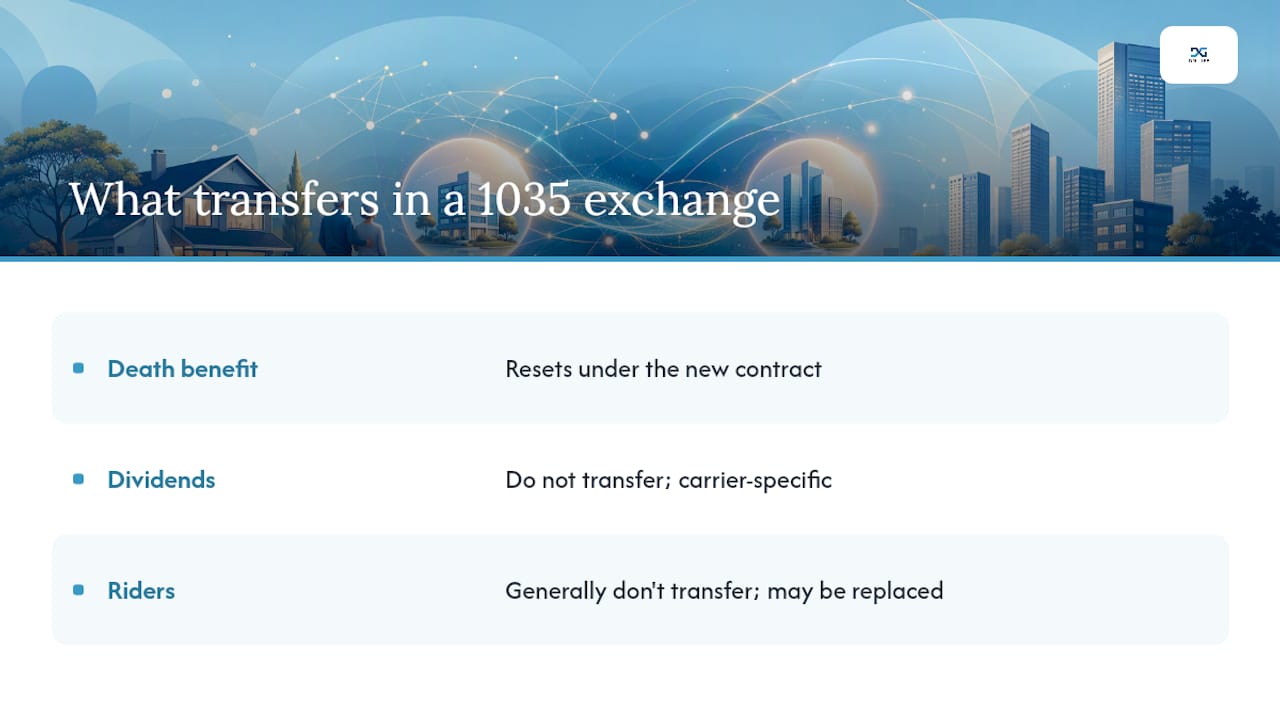
Death benefit amounts reset based on the new contract's design, not the old one. If your current life insurance policy has a $500,000 death benefit and you exchange into a new policy, the new death benefit depends on what that contract offers at your current age and health class, which can be lower if you're older or in worse health than when you originally applied.
Dividends are specific to the issuing carrier and the contract type. A participating whole life policy earning dividends from one carrier doesn't transfer that dividend history or rate to a new carrier's contract. You're starting fresh with whatever dividend scale, if any, the new company offers.
Riders are the biggest wildcard. A living benefits rider, waiver of premium, or accidental death rider attached to your old policy does not automatically carry over. Some receiving carriers offer comparable riders on the new contract; others don't offer that rider category at all. This is precisely why comparing living benefits features before you exchange matters more than comparing premiums alone. Once the old contract surrenders, any rider benefit tied to it is gone, whether or not the new contract replaces it.
Real-World Scenarios: How a 1035 Exchange Plays Out
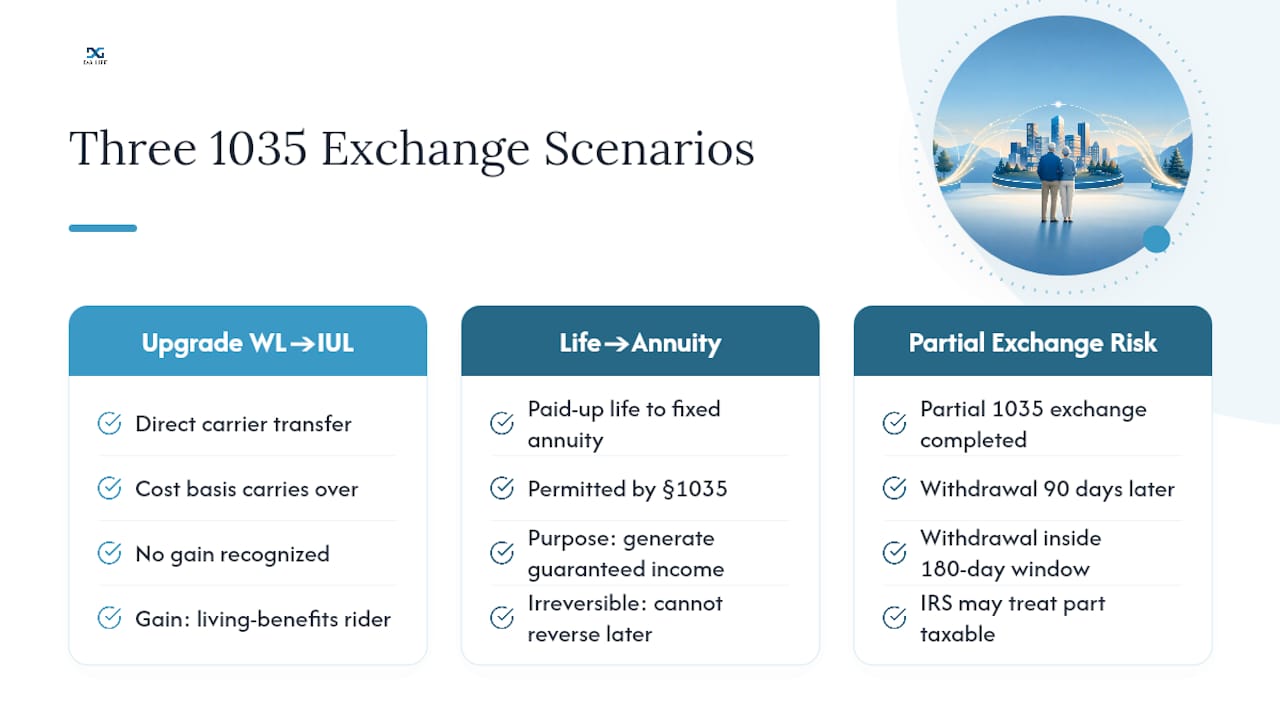
Scenario one: upgrading an old whole life policy. A policyholder bought a whole life policy in the 1990s that's now underperforming compared to current products. She exchanges it into a new indexed universal life policy through a direct carrier transfer. Her cost basis carries over, no gain is recognized, and she gains access to a living benefits rider her original policy never offered. The trade-off: a new surrender period and a fresh underwriting review, since she's technically applying for new coverage even though the funds moved tax-free.
Scenario two: converting life insurance into retirement income. A retiree holding a paid-up life insurance policy she no longer needs for a death benefit exchanges it into a fixed annuity to generate guaranteed income. This works cleanly under §1035 because life-to-annuity transfers are explicitly permitted. She can't reverse this later; moving from an annuity back into life insurance isn't a tax-free option under the code.
Scenario three: a partial exchange gone wrong. A contract owner completes a partial 1035 exchange, then withdraws funds from the new contract 90 days later to cover an unexpected expense. Because that withdrawal falls inside the 180-day window, the IRS can retroactively treat part of the original exchange as taxable. Timing, not intent, decided the outcome.
The DG Life Group Perspective on 1035 Exchanges
Most explanations of a 1035 exchange stop at the tax mechanics. What they skip is suitability. At DG Life Group, we specialize in independent life insurance solutions built around living benefits, working across more than 30 A-rated carriers, which means we're not tied to pushing a single company's product regardless of fit.
When we evaluate a potential exchange, we look past the tax-free label and ask whether the new contract actually improves your estate liquidity, adds meaningful living benefits, or introduces underwriting risk you didn't anticipate. Clients who work with insurance advisers may receive carrier matching based on their health and financial picture, coordinated paperwork between carriers, and follow-up to confirm the receiving carrier recorded cost basis correctly. That last step alone prevents a lot of tax headaches down the road.
— Dev
Get a 1035 Exchange Reviewed Before You Sign Anything
An exchange that looks tax-free on paper can still leave you worse off if the new contract's fees, surrender schedule, or underwriting don't fit your situation. That's the gap a consultative review closes before you commit to anything irreversible.

DG Life Group works across 30+ A-rated carriers, which means a review of your current contract gets compared against real alternatives, not just one company's product shelf. We evaluate whether a 1035 exchange actually strengthens your living benefits access, check whether no-medical-exam options apply to your situation, and coordinate the paperwork between carriers so cost basis gets recorded correctly the first time. If you're holding an old policy that's underperforming or considering a move into an annuity for retirement income, gather your current contract and cash value statement, then request a review. We'll walk through whether an exchange fits your plan before you sign a single form.
Sources
For the statutory language itself, read 26 USC 1035 and Treasury Regulation §1.1035-1. For procedural guidance on partial exchanges and constructive receipt, see Rev. Proc. 2011-38. For a practical walkthrough, the Annuity Journal's process guide covers the carrier-to-carrier steps in plain language.
This article is general information, not a substitute for advice from a qualified financial advisor. Consult a qualified financial professional about your own circumstances before acting on anything here.
- 26 USC 1035: Certain exchanges of insurance policies
- Rev. Proc. 2011-38 (IRS guidance on certain 1035/annuity transfers)
- § 1.1035-1 Certain exchanges of insurance policies (Treasury Regulation)
- How to do a 1035 exchange — Annuity Journal
FAQ
What is a 1035 exchange in simple terms?
It's a tax-free swap of one qualifying life insurance, annuity, or endowment contract for another, done directly between carriers under Internal Revenue Code Section 1035.
Can I do a 1035 exchange from an annuity to life insurance?
No. The code permits life-to-life, life-to-annuity, annuity-to-annuity, and certain long-term care combinations, but not annuity-to-life transfers.
How long does a 1035 exchange take?
Most transfers complete in 2 to 6 weeks, depending on how quickly the surrendering carrier processes the request and whether paperwork is signed correctly the first time.
What happens if I receive the funds directly during an exchange?
If you take constructive receipt of the money instead of having it move carrier to carrier, the IRS treats the transaction as a taxable surrender, not a tax-free exchange.
Does my cost basis carry over in a 1035 exchange?
Yes. Your cost basis transfers to the new contract, which is why confirming the receiving carrier recorded it correctly is worth checking before the exchange finalizes.