

For most families paying off a mortgage or raising kids toward independence, a 20-year term is the most cost-effective way to protect their income for the years that matter most. A healthy 35-year-old typically pays a monthly premium that stays flat for the full 20 years for $500,000 in coverage. If you have a mortgage timeline or a parenting runway that roughly matches two decades, start by estimating your coverage need, then get quotes from a few carriers before you commit.
TL;DR:
- A 40-year-old non-smoker typically pays $47 to $59 monthly for a $500,000 20-year term, with premiums rising sharply with age.
- Most policies do not build cash value or offer refunds unless you add a return-of-premium rider, which increases costs significantly.
- The best candidates for this coverage are those with clear financial obligations ending within 20 years, like mortgages or dependent children’s education.
- Comparing multiple carriers is crucial, as rates can vary greatly based on age, health, and tobacco use, affecting overall affordability.
- Fully underwritten policies take two to six weeks to process, while no-exam options can be approved in minutes, depending on health history and application details.
Table of Contents
- What Is a 20-Year Term Life Policy and How Does It Work?
- How Much Does 20 Year Term Life Insurance Cost?
- Who Is 20-Year Term Life Insurance Best For?
- How Do I Choose the Right Coverage Amount?
- What Riders and Underwriting Paths Should You Know About?
- How Long Does It Take to Get a 20-Year Term Policy?
- When I Recommend a 20-Year Term (and When I Don't)
- Get Your 20-Year Term Quote From Dglifegroup
- Where to Verify These Numbers Yourself
- Sources
- FAQ
What Is a 20-Year Term Life Policy and How Does It Work?
A 20-year term life policy pays a death benefit to your beneficiaries if you die within the 20-year period you selected, and it charges the same premium every single month of that period. Insurers call this "level premium" pricing. You lock in a rate the day you're approved, and unless you add riders that change the math, that number doesn't move again until the term ends. That predictability is the entire selling point of temporary life insurance coverage: you know exactly what you'll pay in year one and in year nineteen.
The mechanics are simple, but the outcomes split into two very different paths. Die during the 20 years, and your beneficiaries receive the full death benefit, tax-free, regardless of how many payments you've made. Outlive the term, and the policy simply ends. You get nothing back, unless you paid extra for a return-of-premium rider, which refunds your premiums if you survive to the term's end. Most buyers skip that rider because it can roughly double or triple the monthly cost, and cheaper coverage is usually the better trade.
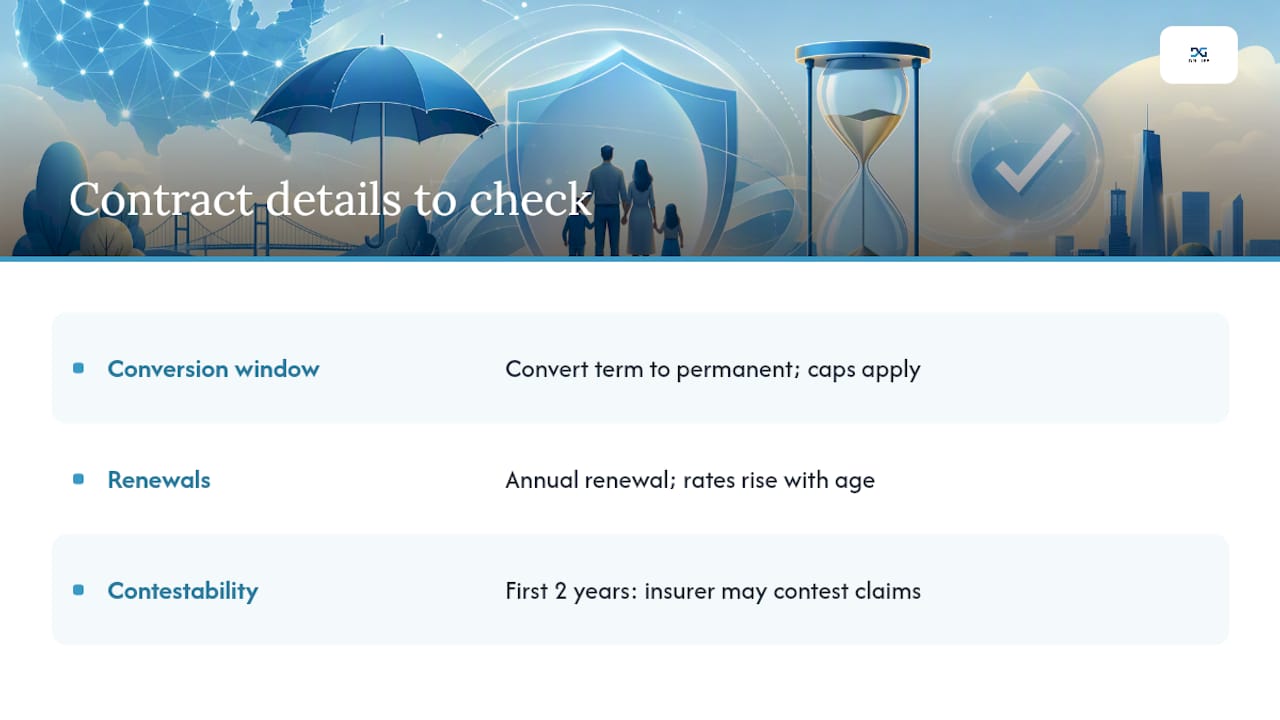
Before you sign anything, check three contractual details that get glossed over in sales conversations. First, the conversion window, the period during which you can convert term coverage to a permanent policy without new medical underwriting. Some carriers cap conversion at age 65 or limit it to the first 10 to 15 years of the term. Second, renewal provisions, since most 20-year policies technically allow annual renewal after the term expires, but at rates that climb sharply with age. Third, the contestability period, typically the first two years, during which an insurer can investigate and deny a claim if it finds a material misstatement on your application. After that window closes, the policy is far harder to contest.
How Much Does 20 Year Term Life Insurance Cost?
Age is the single biggest lever on your rate, and it doesn't move in a straight line. MoneyGeek's rate data shows costs rise exponentially rather than gradually as applicants get older, which is why waiting five years to buy coverage can cost you far more than five years' worth of premiums would suggest.
Here's what that looks like in dollars. A 40-year-old non-smoking applicant can expect to pay roughly $47 to $59 a month for $500,000 of 20-year coverage, depending on the carrier and health class. The table below shows how that range shifts across age and coverage amounts for a healthy, non-smoking applicant.
| Age | $250,000 coverage | $500,000 coverage | $1,000,000 coverage |
|---|---|---|---|
| 30 | $13-$18/month | $20-$28/month | $35-$48/month |
| 40 | $22-$30/month | $47-$59/month | $85-$105/month |
| 50 | $48-$65/month | $95-$125/month | $180-$230/month |
Smoker status changes those numbers dramatically. A 40-year-old smoker applying for the same $500,000 policy will often see significantly higher premiums than a non-smoker in the same age bracket, a gap smoking's documented health risks largely explain through elevated mortality risk.
Pricing drivers that move your quote, ranked roughly by impact:
- Age at application — the largest single factor, and it only gets more expensive the longer you wait.
- Health class — your medical exam results, family history, and lab work sort you into preferred, standard, or substandard tiers.
- Tobacco use — nicotine in any form, including vaping, typically triggers smoker rates.
- Coverage amount and term length — more coverage and longer terms both raise the premium, though not proportionally.
- Occupation and hobbies — pilots, commercial divers, and rock climbers often see rate add-ons.
Age at application drives the pricing curve more than any other factor — a healthy 30-year-old and a healthy 50-year-old can see premiums differ by 5x or more for identical coverage, purely because of the actuarial math behind longer remaining life expectancy.
Every carrier prices risk a little differently, so the ranges above are a starting point, not a quote. Two people with identical health profiles can get meaningfully different offers from different insurers, which is exactly why comparing how much life insurance costs across multiple carriers matters more than accepting the first number you see.

Who Is 20-Year Term Life Insurance Best For?
Three groups tend to get the best value out of a 20-year term, because their financial exposure has a natural expiration date. New parents fall into this bucket almost automatically: 20 years covers a child from birth through college and early independence, which is precisely the stretch where losing a parent's income would hurt the most. Homeowners with a 20-year or 30-year mortgage balance are the second group, since the policy's payout can retire the loan if something happens to the primary earner. Mid-career professionals planning to be mortgage-free and financially independent by retirement round out the third group.
Coverage targets vary by household structure:
- Single parent, one income: aim for 10 to 12 times annual income, plus outstanding debt and future education costs.
- Dual-income family: each spouse often needs separate coverage sized to their own income contribution, not a single shared policy.
- Business owner with a mortgage and employees: factor in business debt obligations on top of personal income replacement.
A 20-year term can fall short for people with lifelong dependents, such as a child with a permanent disability, or for anyone focused on estate liquidity and wealth transfer decades into the future. Those situations usually call for permanent coverage instead, which you can explore further in a term versus whole life comparison.
How Do I Choose the Right Coverage Amount?
Two calculation methods dominate this decision, and both are simple enough to run on a napkin. The DIME method adds up Debt (mortgage, loans, credit cards), Income replacement (annual income multiplied by years until retirement), Mortgage balance, and Education costs for your kids. The income-multiple rule is faster: multiply your annual income by 10 to 12. A household earning $80,000 a year would target roughly $800,000 to $960,000 in coverage under this shortcut.
Here's a worked example. Say you earn $75,000 a year, carry a $220,000 mortgage balance, and want to fund two kids through college at an estimated $60,000 each. DIME math gets you to roughly $75,000 x 15 years (income replacement) plus $220,000 (mortgage) plus $120,000 (education), landing near $1.465 million in target coverage.
- Add up outstanding debt, including your mortgage balance.
- Multiply annual income by the number of years your family would need replacement income.
- Add estimated education costs for each dependent.
- Subtract existing savings and any coverage you already carry.
- Run the total through a life insurance calculator to sanity-check your math.
- Match your term length to your longest financial obligation, usually your mortgage payoff date or your youngest child's projected graduation year.
Before you buy, ask every carrier the same four questions: How long is the conversion window? What happens to my rate at renewal? What's explicitly excluded? And how long is the contestability period?
Pro Tip: When your calculation lands between two coverage tiers, round up rather than down. Modest over-insurance costs you a few extra dollars a month; being underinsured costs your family real money when they need it most.
What Riders and Underwriting Paths Should You Know About?
A handful of add-ons and application paths change how a 20-year term actually performs for your specific situation. The conversion rider lets you switch some or all of your term coverage to permanent insurance later without new medical underwriting, valuable if your health declines during the term. Return-of-premium refunds your premiums if you outlive the term, at a significantly higher monthly cost. Waiver of premium keeps your policy active without payment if you become disabled and can't work. Accelerated (living) benefits let you access a portion of your death benefit while still alive if you're diagnosed with a qualifying critical or terminal illness, converting a future payout into present-day funds for treatment or income replacement.
On the application side, you're choosing between two underwriting paths:
- Fully underwritten policies require a medical exam, lab work, and a longer review, typically two to six weeks, but they usually produce the lowest available rate.
- No-exam (instant-issue) policies skip the exam entirely and can approve coverage in minutes, trading some pricing precision for speed.
For many 20-year buyers, the conversion rider and living benefits address important considerations over two decades: future health and future insurability.
How Long Does It Take to Get a 20-Year Term Policy?
A fully underwritten 20-year term typically takes two to six weeks from application to approval, while a no-exam policy can issue in minutes to a few days. The gap comes almost entirely from the medical exam and lab review.
- Complete an application with your health history, income, and beneficiary information.
- Schedule a paramedical exam if you're going the fully underwritten route (blood pressure, blood draw, urine sample).
- Underwriters review your exam results, medical records, and sometimes a prescription history database.
- The carrier issues an offer, which may match your applied-for rate or come back at a different rating class.
- You accept the offer, pay your first premium, and coverage takes effect.
A few things reliably slow this process down: a recent DUI, an untreated medical condition flagged in your records, or inconsistencies between your application and your medical history. Recent negative events like a DUI or recent cardiac treatment can push your rate up by 50% to 200% or trigger a decline outright, depending on the carrier and how recent the issue is. Speed things up by disclosing everything accurately upfront, gathering recent medical records before you apply, and documenting smoking cessation if you quit within the past year, since some carriers will reclassify you as a non-smoker after 12 months tobacco-free.
When I Recommend a 20-Year Term (and When I Don't)
A 20-year term is the right call for the buyer whose financial risk has a clear end date: a mortgage that gets paid off, kids who become financially independent, or a career stretch that ends in a fully funded retirement. If your risk window matches that shape, this is usually the most efficient coverage you can buy.
I steer people toward a 30-year term or permanent coverage when their obligations don't have a 20-year expiration, lifelong dependents, younger children with a longer runway to independence, or estate planning goals that outlast any term policy. And for buyers with health conditions that make traditional underwriting a gamble, I'd rather see them explore no-exam options and living benefits upfront than delay coverage while chasing a marginally better rate through a lengthy exam process. Speed and certainty sometimes beat a slightly lower premium.
— Dev
Get Your 20-Year Term Quote From Dglifegroup
An independent broker can give you access to multiple A-rated insurers, so you're comparing real rates instead of guessing at one company's number. That matters most for a 20-year term, where a few dollars a month of difference compounds over 240 payments. Specializing in living benefits and no-exam options can offer a fast path to coverage when traditional underwriting is difficult due to health conditions or tight timelines.

Getting a quote takes minutes, not weeks. Check instant term life rates or review full pricing across term, whole, and universal life to see where you land. Providing your age, approximate health history, and target coverage amount can help you get a personalized quote often in a short time, especially for no-exam applicants.
Where to Verify These Numbers Yourself
Run your own sample-rate check against MoneyGeek's 20-year term rate tables and cross-reference pricing factors on The Zebra's cost breakdown. For the demographic backdrop behind age-based pricing, the CDC's mortality data brief lays out the longevity trends insurers build their tables around. If you're comparing the cost of waiting to buy versus buying now, this Florida-focused breakdown on delayed purchases walks through real numbers on that tradeoff.
This article is general information, not a substitute for advice from a qualified financial advisor. Consult a qualified financial professional about your own circumstances before acting on anything here.
Sources
- The Zebra — factors that affect life insurance cost
- CDC — NCHS data brief
- PocketGuard — average life insurance cost
FAQ
How Much Does a 20-Year Term Life Insurance Policy Cost?
A healthy 40-year-old non-smoker typically pays $47 to $59 a month for $500,000 of coverage, while a healthy 30-year-old often pays less than half that for the same coverage amount. Your exact rate depends on age, health class, tobacco use, and the carrier you choose, so getting a few quotes matters more than any single sample figure.
Can You Cash Out a 20-Year Term Life Insurance Policy?
No, standard 20-year term policies don't build cash value and can't be cashed out. The only exception is a return-of-premium rider, which refunds your paid premiums if you outlive the term, though that rider significantly raises your monthly cost.
What Happens to a 20-Year Term Policy After the Term Ends?
If you outlive the 20 years, coverage simply expires and you receive no payout unless you added a return-of-premium rider. Most policies allow renewal at that point, but renewal rates climb steeply with age, which is why many people convert to a permanent policy before the term ends, using a conversion rider if the policy includes one.
Is 20-Year Term Life Insurance Worth It?
For most families covering a mortgage or raising children, a 20-year term is one of the most cost-effective ways to protect income during those specific years. It's less suited to lifelong financial obligations, where permanent coverage or a longer term fits better.
Does Dglifegroup Offer No-Exam 20-Year Term Policies?
Yes, Dglifegroup works with carriers offering no-exam, instant-issue term policies alongside fully underwritten options. You can compare both paths and get a personalized quote based on your health history and coverage goals.