

An accelerated death benefit lets you draw part of your life insurance payout while you're still alive, once you meet a specific medical trigger. It provides tax-free cash for terminal illness in most cases, but every dollar you take reduces what your beneficiaries eventually receive. Terminal claims typically require a physician's certification of 12 to 24 months life expectancy, chronic illness claims require documented help with daily activities, and critical illness triggers depend on the exact diagnosis list in your rider.
TL;DR:
- Most payout calculations involve a discount of 5% to 15%, reducing the net amount received compared to the requested acceleration.
- Eligibility primarily depends on physician certification of 12 to 24 months, or showing inability to perform daily activities for chronic illness claims.
- Maximum payouts often cap at 25% to 95% of the policy’s face value or around $250,000 to $500,000, with administrative fees usually under $500.
- The benefit’s tax treatment favors terminal illness claims, which are generally tax-free if certified within the standard window, but chronic and critical illness payouts may have tax implications.
- Accelerated benefits usually do not reduce future premiums or cash value, but a large payout could affect Medicaid or SSI eligibility, requiring prior benefits planning.
Table of Contents
- How Does an Accelerated Death Benefit Rider Work?
- Who Qualifies for an Accelerated Death Benefit?
- How Much Money Can You Actually Get?
- What Does an Accelerated Death Benefit Cost You?
- What's the Process for Claiming an Accelerated Death Benefit?
- Should You Accelerate the Benefit or Sell the Policy Instead?
- How DG Life Group Helps With Living Benefits Decisions
- A Straight Answer on Accelerated Benefits
- Get Your Policy Reviewed Before You Need the Benefit
- Where to Verify These Details Yourself
- Sources
- FAQ
How Does an Accelerated Death Benefit Rider Work?
Carriers use one of three methods to calculate your payout, and the difference between them can mean thousands of dollars.
- Discount method: The insurer applies an actuarial discount to the accelerated portion, reflecting the time value of paying out early. Reported discounts commonly run 5% to 15%, so a $100,000 acceleration might net $85,000 to $95,000 before fees.
- Lien method: The insurer treats the payout as a loan against the death benefit, charging interest that accrues until death. Your beneficiaries get the remaining death benefit minus the lien and accrued interest.
- Dollar-for-dollar method: Less common, this simply subtracts the exact amount accelerated from the final payout, with no discount applied.
Your cash value and future premium obligations rarely disappear when you accelerate. Most contracts still require you to pay premiums on whatever death benefit remains, and cash value often drops proportionally. Some riders pay in a single lump sum; others allow periodic installments, though that depends entirely on your specific contract language.
Who Qualifies for an Accelerated Death Benefit?
Eligibility comes down to which rider you hold and what your policy defines as a qualifying event. The three standard categories each carry their own certification rules.
- Terminal illness riders require a physician's written certification that you have a life expectancy of 12 to 24 months, depending on the carrier. That window matters because a diagnosis outside it simply won't qualify, even if the illness is serious.
- Chronic illness riders typically require certification that you cannot perform at least two of six activities of daily living (bathing, dressing, eating, toileting, transferring, and continence), or that you have severe cognitive impairment. Many chronic riders demand annual recertification to keep payments flowing.
- Critical illness riders trigger on a specific list of diagnosed events, like a heart attack, stroke, or invasive cancer. Wording matters enormously here: a rider that names "invasive cancer" may exclude an early-stage or in-situ diagnosis entirely, so read the actual contract, not the marketing summary.
Whichever category applies, expect to submit a claim form, a physician's statement, supporting medical records, proof of identity, and consent from any assignee or trustee if the policy sits inside an irrevocable life insurance trust. Most insurers accept your treating physician's certification without argument, though they reserve the right to request an independent second opinion, at their own expense, if the diagnosis is contested.
How Much Money Can You Actually Get?
Payout ceilings vary by carrier and rider, but two limits show up repeatedly in filed contracts: a percentage cap on the policy's face amount and a hard dollar ceiling. Filed rider language shows maximums as low as 50% of face value with dollar ceilings around $250,000 on some products, alongside minimum payment thresholds and one-time processing charges.
Quick math on the discount: if your policy discounts at 10% and you request $200,000, expect roughly $180,000 net before administrative fees, which commonly range from $0 to $500.
Tax treatment is where accelerated benefits genuinely outperform other ways of tapping a policy early. Under Internal Revenue Code section 101(g), a terminal illness payment certified within the standard window is generally treated the same as a death benefit and excluded from your gross income. Chronic illness payments follow separate per-diem rules, which cap the daily tax-free amount and can create taxable income if you exceed it.
- Percentage caps: often 25% to 95% of face value, carrier-dependent.
- Dollar ceilings: commonly $250,000 to $500,000 on many riders.
- Actuarial discounts: typically 5% to 15%.
- Administrative fees: usually $0 to $500, one-time.
One more wrinkle deserves attention before you sign anything: a large accelerated payment can push your countable assets over Medicaid or SSI limits, jeopardizing benefits you may already depend on. Anyone weighing a big payout against means-tested benefits should talk to a benefits planner or elder law attorney first, not after the check clears.
What Does an Accelerated Death Benefit Cost You?
The rider itself is frequently free. Most terminal illness riders come attached to a new policy at no extra premium, since insurers view them as low-risk additions given the narrow qualifying window. Chronic illness and critical illness riders, by contrast, often carry an added cost, because they pay out more frequently and over a longer horizon.
Beyond the rider premium, three things reduce your net proceeds:
- The actuarial discount or lien interest applied to the accelerated amount.
- Any outstanding policy loan, which the insurer typically deducts before releasing funds.
- One-time administrative or processing fees charged at the time of the claim.
The real trade-off isn't the fee schedule. It's the reduced survivor benefit and the fact that your premium obligation on the remaining coverage usually doesn't change, even though your death benefit just shrank.
Pro Tip: Before you accept any offer, request an in-force illustration from your carrier. It's the only document that shows your exact net payout, the discount or lien interest applied, and the death benefit your family will actually receive afterward.
What's the Process for Claiming an Accelerated Death Benefit?
Filing a claim follows a predictable sequence, and knowing it in advance saves weeks.
- Locate your policy and confirm which rider you hold and its exact trigger language.
- Contact the carrier's claims department and request the accelerated benefit claim packet.
- Have your physician complete the certification statement, and gather supporting medical records.
- Submit the claim form with proof of identity and any required assignee or trustee consent.
- Ask the carrier directly which calculation method it uses (discount, lien, or dollar-for-dollar), what fees apply, and whether periodic payments are an option.
Expect 30 to 90 days from a complete submission to payout. Incomplete physician statements cause most of the delays insurers report, so double-check that section before you mail anything. If your claim is denied, you can appeal directly with the carrier, and it's worth bringing in your agent, broker, or an attorney at that stage. Understanding what happens after a policyholder dies also helps you see how acceleration paperwork compares to a standard death claim.
Should You Accelerate the Benefit or Sell the Policy Instead?
Accelerating keeps your policy in force, with a reduced death benefit remaining for your beneficiaries. A viatical or life settlement takes the opposite approach: you sell the entire policy to a third party for a negotiated lump sum, ending your premium payments but eliminating any death benefit entirely.
- Choose acceleration when you want to preserve some benefit for survivors and need faster access to cash.
- Consider a viatical settlement when your prognosis is very short and stopping premium payments matters more than leaving anything behind.
- Regulatory oversight differs by state, so get multiple offers before choosing either path.
- Weigh urgency, family needs, and the net dollar comparison between the two options before deciding.
How DG Life Group Helps With Living Benefits Decisions
Reading rider language alone won't tell you what your specific claim is worth. DG Life Group specializes in living benefits and works with over 30 A-rated carriers, which means we can pull your in-force illustration, interpret the actual rider wording against your diagnosis, and compare how different carriers calculate net payouts.
- Requesting in-force illustrations that show your exact net payout before you file.
- Interpreting discount versus lien language so you know what you're actually signing.
- Coordinating claim paperwork directly with carrier claims departments.
- Referring clients to tax and benefits professionals when a payout could affect Medicaid or SSI eligibility.
Our no-medical-exam policies also matter here: if you're helping a family member plan ahead rather than react to a current diagnosis, coverage can often be in place quickly, before any health event makes acceleration relevant.
A Straight Answer on Accelerated Benefits
Accelerated death benefits solve a real problem: medical bills and lost income don't wait for probate. But the decision to use one deserves the same scrutiny you'd give any major financial move, not a signature rushed through during a crisis. Pull your policy, request the claim packet, get an in-force illustration, and talk to a tax or benefits advisor before you accept a number. Those three steps take a few days and can save you far more than that in avoided mistakes.
— Dev
Get Your Policy Reviewed Before You Need the Benefit
Dglifegroup exists for exactly the moment this article describes: when you need a straight answer about what your coverage can actually do for you, not a sales script. As an independent broker working with 30+ A-rated carriers, we compare rider language and payout mechanics across companies instead of pushing one insurer's fine print, and premiums stay identical no matter which channel you buy through.

If you're shopping for new coverage with living benefits built in, term life plans start between $20 and $85 a month, and no-medical-exam options can often get you protected within minutes. If you already own a policy and want to know what an accelerated benefit would actually pay out, request a policy review and quote at Dglifegroup today.
Where to Verify These Details Yourself
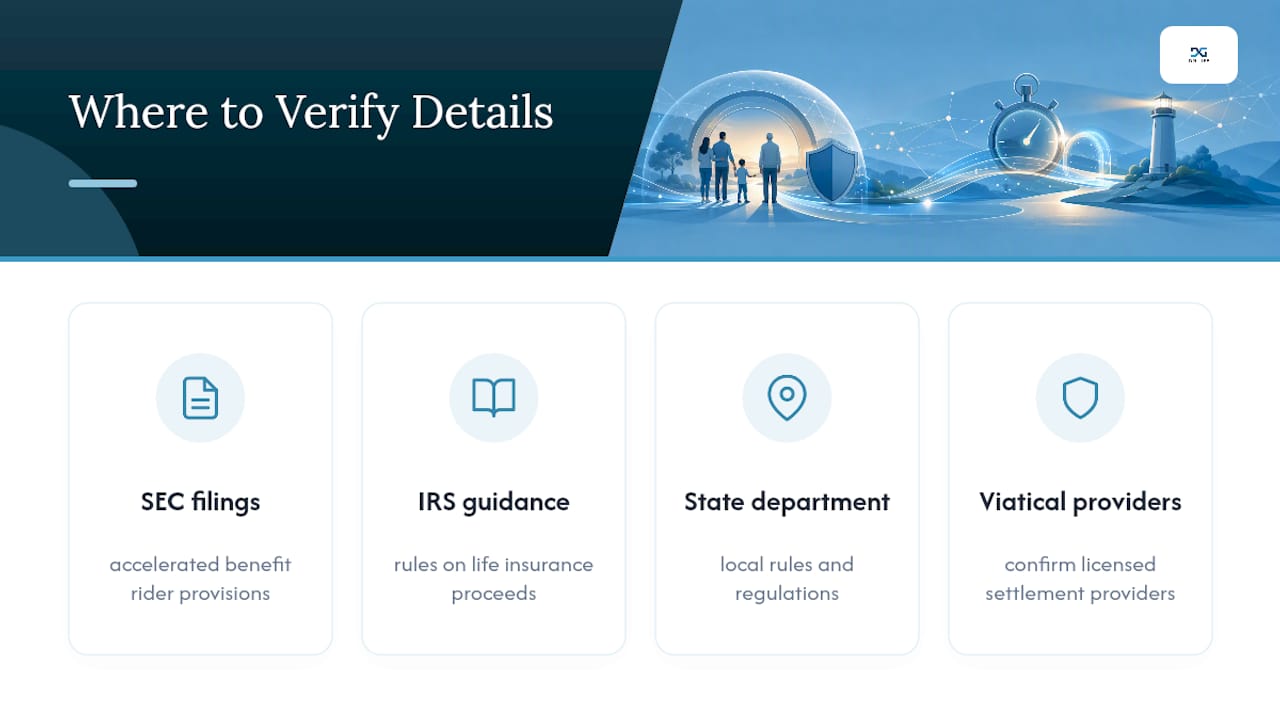
Rider language, fees, and caps vary by carrier, so check the primary sources directly: the SEC filing on accelerated benefit rider provisions and IRS guidance on life insurance proceeds. Your state insurance department can also confirm local rules and licensed viatical settlement providers.
This article is general information, not a substitute for advice from a qualified financial advisor. Consult a qualified financial professional about your own circumstances before acting on anything here.
Sources
- SEC filing excerpts on accelerated benefit rider provisions
- IRS — life insurance and disability insurance proceeds (FAQ)
FAQ
Is an Accelerated Death Benefit Worth It?
It's worth it when you need cash now for medical bills or income replacement and you're comfortable reducing what beneficiaries eventually receive. For terminal illness claims, the payment is generally tax-free under IRC section 101(g), which makes it more efficient than many other emergency funding options.
What Triggers an Accelerated Death Benefit Payment?
Terminal illness riders trigger when a physician certifies a life expectancy of 12 to 24 months. Chronic illness riders trigger when you can't perform at least two of six activities of daily living, and critical illness riders trigger on specific diagnosed events listed in your contract.
What Is an Accelerated Death Payment?
It's a portion of your life insurance death benefit paid to you while you're still alive, once you meet your rider's medical trigger. The insurer calculates the amount using a discount, lien, or dollar-for-dollar method, and the remaining death benefit passes to your beneficiaries later, minus whatever you accelerated.
Do You Have to Pay Taxes on Accelerated Death Benefits?
Terminal illness payments certified within the standard window are generally excluded from gross income under IRC section 101(g). Chronic illness payments follow separate per-diem rules and can become partially taxable if they exceed the daily limit, so confirm your specific situation with a tax professional before you file.