

Accelerated underwriting can approve qualifying applicants in minutes to a few days by pulling electronic health, prescription, and driving records into predictive models instead of scheduling a paramedical exam. It works well for healthy adults with clean records, but complex medical histories or data gaps still get routed to a human underwriter. Some independent brokers place policies through multiple A-rated carriers, several of which run accelerated programs, so the exam-free path may be available on the first application, not a fallback.
TL;DR:
- Accelerated underwriting is most effective for healthy applicants under the mid-50s with a clean medical and driving record and a modest coverage request.
- Approval can be achieved within minutes or hours for straightforward cases, but complex or flagged files often still go to traditional review, taking weeks.
- Data accuracy and a thin digital footprint improve chances of rapid approval, while outdated records or health issues may lead to manual underwriting.
- The process involves minimal applicant input but grants access to sensitive data like prescription and driving records, which can impact privacy.
- Using multiple carriers can increase approval chances since model scoring varies, and some applicants may qualify with one insurer but not another.
Table of Contents
- What Is Accelerated Underwriting Life Insurance?
- How Does the Accelerated Underwriting Process Work?
- Who Typically Qualifies for Faster, Exam-Free Approval?
- Benefits and Drawbacks of Skipping the Medical Exam
- What NAIC Guidance Means for You
- How to Apply and What to Expect Along the Way
- When Accelerated Underwriting Flips to Manual Review
- What Fifteen Years Of Watching This Industry Change Has Taught Us
- Get an Accelerated Underwriting Quote Without the Guesswork
- Sources
- FAQ
What Is Accelerated Underwriting Life Insurance?
Accelerated underwriting life insurance replaces the traditional paramedical exam with electronic data and predictive modeling for applicants who fit a carrier's low-risk profile. Instead of a nurse drawing blood and recording your blood pressure, the insurer pulls prescription histories, motor vehicle records, and other digital sources, then runs that data through a statistical model that estimates mortality risk about as accurately as a lab test would. The NAIC describes this shift as one that can compress approval timelines from weeks or months down to hours or days for applicants who qualify.
It helps to separate accelerated underwriting from simplified issue, because people often lump them together. Simplified issue asks a short list of health questions, skips all medical evidence entirely, and charges a premium for that convenience. Accelerated underwriting still evaluates full underwriting factors. It just gathers that evidence electronically instead of physically, so pricing usually lands closer to fully underwritten, traditional rates rather than the marked-up simplified-issue tier.
Carriers did not adopt this approach out of generosity. Paramedical exams cost money, take weeks to schedule and process, and applicants frequently abandon the purchase while waiting on results. Removing that friction lowers acquisition costs for insurers and gets a death benefit in force faster for the buyer. Both sides win when the applicant's data checks out clean, which is precisely why the industry has invested so heavily in refining these programs since their broader rollout during 2020 to 2022, according to Munich Re's underwriting trends analysis.
If you're weighing accelerated underwriting against a no-medical-exam policy, the distinction matters for both your wallet and your timeline.
How Does the Accelerated Underwriting Process Work?
The process runs on a fairly predictable sequence, even though the technology behind it is anything but simple. Understanding the steps helps you know what's happening behind the scenes while you wait for a decision.
- Application and consent. You answer health and lifestyle questions and sign authorization forms allowing the insurer to pull third-party records.
- Data retrieval. The system queries the MIB Group database, prescription history databases, motor vehicle records, and sometimes credit-based insurance scores, all within seconds to minutes.
- Predictive scoring. A statistical model, trained on mortality data, converts that information into a risk score comparable to what a traditional exam would have produced.
- Rules engine review. Business rules check the score and data against the carrier's underwriting guidelines for the requested face amount and rate class.
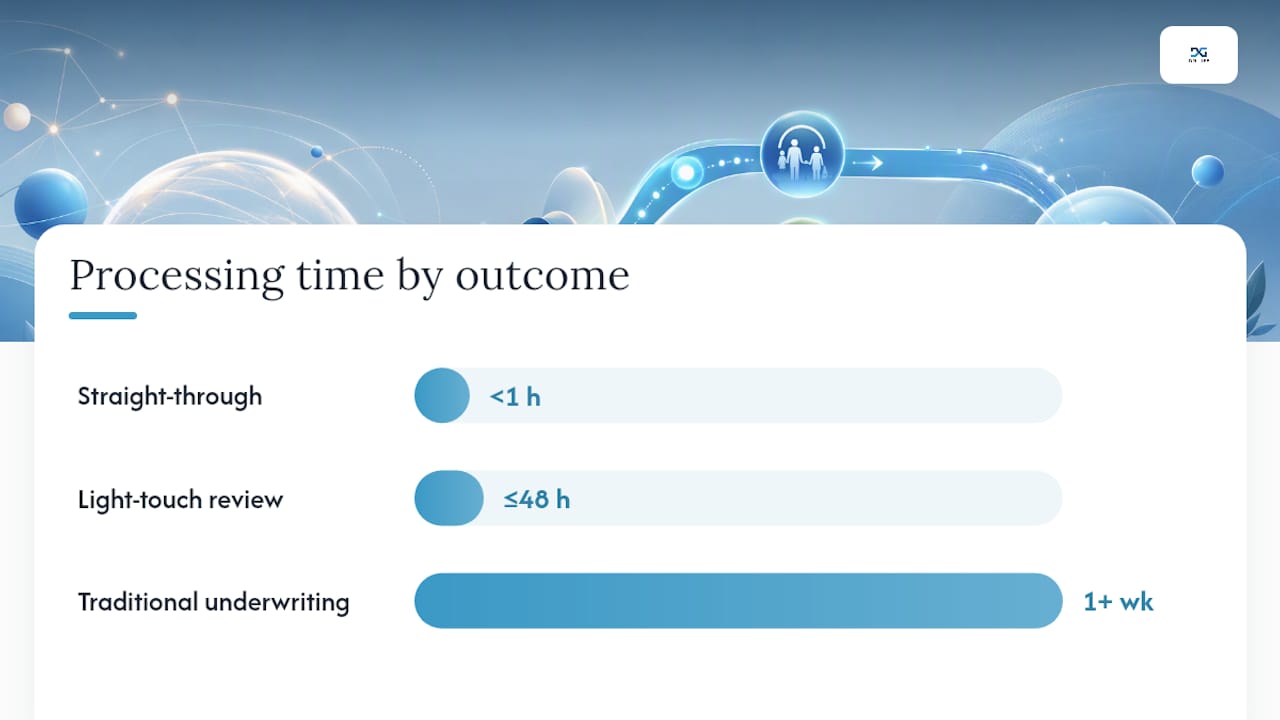
- Outcome. The application either approves straight through, gets flagged for a light-touch human review, or escalates to full traditional underwriting.
According to Sapiens' breakdown of accelerated underwriting, this sequence is what allows many eligible cases to clear instantly while genuinely complex ones still land on an underwriter's desk. Speed varies by outcome. Straight-through approvals can land within minutes of submitting your application. Cases needing a quick manual glance often clear the same day or within 48 hours. Files that get bumped to traditional underwriting, usually because of a flagged prescription or missing data, can take one to several weeks, similar to a conventional application.
It's worth knowing that straight-through processing still represents a minority share of total applications industry-wide, even at carriers running mature programs, per Sapiens' analysis. Human underwriters remain part of the picture for a meaningful chunk of cases, which is a feature, not a flaw. A model that auto-approved everything without exceptions would be a red flag, not a selling point.
Who Typically Qualifies for Faster, Exam-Free Approval?
The applicants who sail through accelerated underwriting share a fairly consistent profile: generally healthy adults in a defined age band, requesting a face amount within the carrier's program limits, with a prescription and medical history that raises no red flags. Carriers set these boundaries deliberately, and they vary by company.
- Age range. Most programs target applicants roughly between their mid-20s and mid-50s, though some carriers extend further.
- Face amount caps. Coverage limits historically topped out around $1 million, but Munich Re's survey work shows average maximums have climbed toward multi-million-dollar bands at some carriers.
- Health profile. No recent hospitalizations, no high-risk prescriptions, and a driving record free of major violations.
- Digital footprint. A thin record, someone who rarely sees doctors or fills prescriptions, can actually work against you, since the model has less data to confirm low risk.
- Larger requests, tighter scrutiny. Carriers commonly require a stronger data footprint before extending accelerated treatment to bigger policies, a practice known as banded underwriting.
If you carry a chronic condition like diabetes, coverage is still very achievable, though it may route through a specialized underwriting path. Our guide to life insurance with diabetes walks through what that process looks like in practice.
Benefits and Drawbacks of Skipping the Medical Exam
Accelerated underwriting delivers real advantages, but it isn't a free upgrade with zero trade-offs. Weighing both sides honestly will save you a surprise later.
What you gain:
- Approval in minutes to days instead of weeks, for eligible applicants.
- Pricing that often matches traditional, fully underwritten rates rather than the higher premiums simplified issue charges, per Sapiens.
- No needle, no nurse visit, no scheduling around your work week.
What you give up:
- Less control over the narrative. A model reads your data cold, with no chance to explain context a human underwriter might have asked about.
- Privacy exposure. You're granting access to prescription and driving history databases, and that data trail doesn't disappear once the policy issues.
- Not universal. If your file doesn't fit the model's comfort zone, you're back to traditional underwriting timelines anyway.
Simplified issue still has its place, mainly for applicants who want speed above all else and are willing to pay more for it, or whose health history makes accelerated approval unlikely.
Pro Tip: Before applying, pull your own MIB report so you're not blindsided by an old flag from a policy application years ago. Errors happen more often than most people expect, and catching one early can prevent an unnecessary kickout to manual review.
What NAIC Guidance Means for You
Regulators haven't left accelerated underwriting to run unchecked. The NAIC's regulatory guidance package treats these programs as an ongoing risk-management responsibility for insurers, not a one-time tech rollout, and it lays out specific expectations:
- Transparency about data inputs. Insurers should be able to explain what data sources feed their models.
- Testing for unfair discrimination. Programs must be evaluated to confirm they don't produce disparate outcomes across protected classes.
- Data security. Third-party data pulled into the model has to be protected under the same standards as other sensitive consumer information.
- Explanation for adverse decisions. If you're declined or referred to traditional underwriting, you're entitled to understand why.
- Error-correction mechanisms. There has to be a path to dispute and fix inaccurate data feeding the decision.
The guidance frames these programs as needing continuous monitoring rather than a single approval and forget-it setup, an insight worth remembering if a carrier ever seems vague about how its model works.
Behavioral and third-party data introduce risk precisely because they're pulled from sources you don't control, like prescription databases that occasionally mismatch names or dosages. Before you apply anywhere, it's fair to ask an insurer or broker:
- What specific data sources feed your accelerated program?
- How do you test the model for unfair discrimination?
- What happens if my application gets referred to manual underwriting?
- How will I be notified, and what will the notice explain, if I'm declined?
- What's the process to dispute or correct inaccurate data?
A broker who can't answer those five questions plainly probably hasn't looked closely at the carriers they're placing with.
How to Apply and What to Expect Along the Way
Preparation shortens your timeline more than almost anything else in this process. A little groundwork before you hit submit prevents most of the delays applicants run into.
- Gather your basics first. Height, weight, medications, dosages, and your primary care doctor's contact information.
- Check your MIB file in advance. Old or inaccurate records are a common, avoidable reason for a kickout to manual review, and you can request your MIB report directly.
- Review your own prescription history. If something looks outdated or wrong, flag it before an underwriter does.
- Answer consistently. Contradictions between your application and pulled records are one of the fastest paths to a referral.
- Expect a range of timelines. Straight-through cases often clear within minutes to a day; referred cases can take one to several weeks, similar to conventional underwriting, as detailed in our breakdown of how fast you can get life insurance.
A broker matching you across multiple carriers, rather than pushing one company's program, can also steer your application toward whichever insurer's accelerated model best fits your specific health profile.
When Accelerated Underwriting Flips to Manual Review
A handful of triggers commonly send an application from the fast track to full traditional underwriting: conflicting data between your application and pulled records, a flagged MIB entry, a recent hospitalization, or a face amount above the carrier's accelerated threshold.
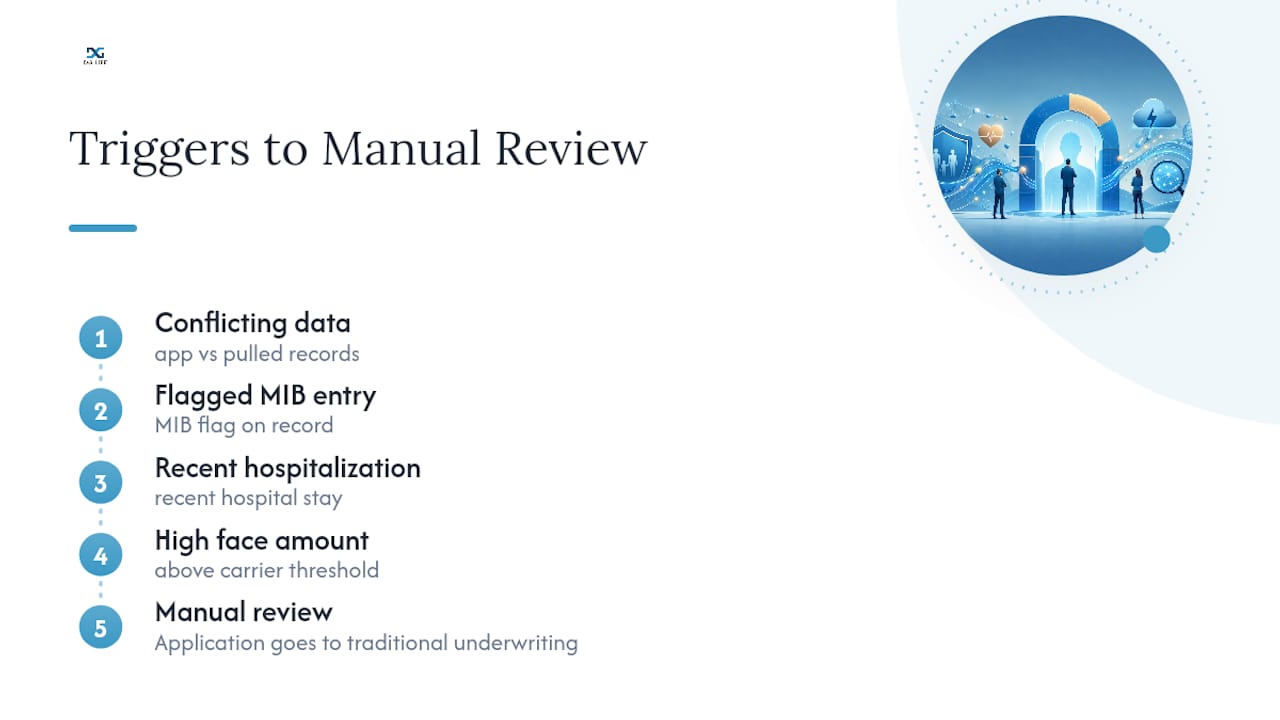
If that happens, don't panic. Respond promptly to any request for additional information, since delays on your end simply add to the delay on theirs. Gather your own medical records if the underwriter needs clarification, and ask specifically what triggered the referral. You're entitled to that explanation under NAIC guidance. If the issue traces back to a data error, request a formal correction from the source, whether that's MIB or a prescription database, and ask your broker to resubmit once it's fixed rather than starting over from scratch.
What Fifteen Years Of Watching This Industry Change Has Taught Us
Most coverage of accelerated underwriting treats it like a magic speed button. It isn't. It's a risk-assessment shortcut that works beautifully for the applicants it's built for, and does nothing for the ones it isn't. The overlooked variable is data quality, not technology. An outdated MIB flag or a mismatched prescription record can push a genuinely healthy applicant into a manual review queue that a five-minute records check could have prevented.
Policies can be placed across more than 30 A-rated carriers precisely because no single insurer's accelerated model fits every applicant. A client with a decade-old prescription flag might sail through with one carrier's program and get referred by another. That's not a flaw in accelerated underwriting. It's a reason to shop it with someone who knows which carriers run the least restrictive programs for your specific health picture, rather than applying blind with one company.
— Dev
Get an Accelerated Underwriting Quote Without the Guesswork
Brokers may match clients against multiple A-rated carriers running accelerated underwriting programs, so if one carrier's model flags something in your file, another may not. That matters because no two insurers score risk identically, and applying blind to just one company means you risk being subject solely to that model's decision.
Some brokers specialize in no-medical-exam options, living benefits that let clients access part of their death benefit while still alive, and impaired-risk placement for applicants with health conditions that trip up standard programs. If you want to see where you'd likely land, start with instant term life insurance rates to get a real quote in minutes, or browse our life insurance comparison tables if you're still weighing policy types. Either way, you'll know your options before you commit to a single carrier's underwriting model.
This article is general information, not a substitute for advice from a qualified financial advisor. Consult a qualified financial professional about your own circumstances before acting on anything here.
Sources
- Insurance Topics | Accelerated Underwriting
- Accelerated Underwriting: An In-Depth Guide | Sapiens
- Accelerated underwriting trends: eligibility limits, digital health data, and the quest for automation | Munich Re
FAQ
Is an Accelerated Death Benefit Worth It?
For most policyholders facing a qualifying illness, yes: it provides tax-free access to part of your death benefit while you're alive, without the interest costs of a loan. Whether it's worth it for you depends on your remaining coverage needs, since using the benefit reduces the payout your beneficiaries eventually receive.
What Happens if You Receive Accelerated Death Benefits?
Your policy's death benefit is reduced by the amount you accelerate, plus any fees the carrier charges for early access. The funds themselves are typically received tax-free when tied to a qualifying terminal or chronic illness.
How Long Does Underwriting Take to Approve a Life Insurance Policy?
With accelerated underwriting, many qualifying applicants get approved within minutes to a few days. Applications referred to traditional underwriting, often due to data gaps or health flags, can take one to several weeks.
What Qualifies for an Accelerated Death Benefit?
Qualification generally requires a diagnosis of a terminal illness, or in some policies a chronic or critical illness, as defined by the specific rider attached to your policy. Exact triggers vary by carrier and by the rider's terms, so it's worth confirming the definitions before you buy.