

The contestability period is a window after a U.S. life insurance policy takes effect during which the insurer can investigate application accuracy and, in limited cases, deny a claim over material misstatements. If a death occurs during that window, expect the insurer to review the file before paying out. Once the two years pass, the policy generally becomes incontestable.
TL;DR:
- Most claims during the two-year contestability period are examined only if there are red flags, such as unusual timing or cause of death.
- Insurers can investigate disclosures related to health history, tobacco use, and misstatements that would have affected underwriting decisions.
- Denials mainly result from material misrepresentation, like undisclosed diagnoses or false smoking status, rather than minor mistakes or honest errors.
- Reinstating a lapsed policy typically restarts the contestability window, so applicants should clarify whether the original or new period applies.
- After the contestability period ends, generally two years, insurers cannot deny claims over application misstatements unless fraud or unpaid premiums are involved.
Table of Contents
- Understanding the Contestability Period in Life Insurance: Coverage and Timing
- Why Insurers Build In a Contestability Period
- How a Contestability Investigation Unfolds After a Claim Is Filed
- Common Reasons Claims Get Denied During Contestability
- Contestability Period vs. the Incontestability Clause and Suicide Clause
- What to Do If a Claim Is Denied During Contestability
- Does a Lapsed Policy or Reinstatement Restart the Clock?
- How Providers Reduce Contestability Risk for Clients
- A Broker's Take on Avoiding Contestability Trouble
- Get Ahead of Contestability Before You Need To
- Where This Information Comes From
- Sources
- FAQ
Understanding the Contestability Period in Life Insurance: Coverage and Timing
The clock starts on the policy's effective or issue date, not the day the application was signed or submitted. That distinction matters because underwriting delays of several weeks are common, and beneficiaries sometimes miscalculate the window using the wrong start date.
During this period, the insurer can scrutinize almost everything the applicant reported. Coverage under this scrutiny typically includes:
- Health history, diagnoses, and treatment records disclosed or omitted on the application
- Tobacco and nicotine use, since misreporting it changes the premium calculation
- Age, income, and occupational risk factors used to price the policy
- Prior insurance applications or denials that weren't disclosed
This standard applies broadly across what is the life insurance contestability period for both term and permanent products, though state insurance codes set the actual floor. Most states mirror the two-year norm, but a handful allow slight variation, so the exact language in your policy's contestability clause is the final word.
Why Insurers Build In a Contestability Period
Insurers price every policy based on the honesty of the application. A smoker who claims nonsmoker status, or an applicant who leaves out a cardiac diagnosis, shifts risk onto every other policyholder in that pricing pool. The contestability period gives carriers a defined runway to catch that kind of misrepresentation before it becomes a permanent, unchallengeable liability.
Underwriting depends on truthful disclosure because insurers can't independently verify every claim an applicant makes at the time of application. The contestability window functions as a backstop, giving insurers time to:
- Cross check medical records against what was reported
- Confirm tobacco and substance use history
- Verify that the policy was issued based on accurate facts, not omissions
- Preserve pricing fairness for the broader pool of policyholders
How a Contestability Investigation Unfolds After a Claim Is Filed
Filing a death claim inside the contestability window doesn't automatically trigger a deep investigation. Most claims move through standard processing. Investigations tend to start when something looks unusual, like a death occurring very early in the policy term or a cause of death that seems inconsistent with the application's health disclosures.
- The beneficiary files the claim and submits a certified death certificate.
- The insurer reviews the file for red flags tied to the timing or cause of death.
- If flagged, the insurer requests supporting records: MIB file history, pharmacy fill records, physician notes, hospital records, and sometimes autopsy or toxicology reports.
- The insurer compares those records against the original application.
- The claim resolves as full payment, a reduced benefit, or denial with rescission.
Most policyholders never see this process play out, since investigations are triggered by specific red flags rather than applied to every claim filed during the two years, according to MoneyGeek. Timelines vary, but responding fast with organized records shortens the process considerably.
Pro Tip: Keep a copy of your original application and any medical exam results in a fireproof folder alongside your policy documents. It turns a records request from a weeks-long scramble into a same-day response.
Common Reasons Claims Get Denied During Contestability
Denials during this window almost always trace back to material misrepresentation, meaning the false or omitted information would have changed the underwriting decision or the premium charged. Typical scenarios include:
- A serious diagnosis, like cancer or heart disease, that existed before applying and went undisclosed
- Tobacco or vaping use reported as "never" when records show otherwise
- Misstated age, income, or occupation that materially affected the rate class
- Non-payment of premiums, which can lapse a policy regardless of contestability status
- Exclusions written into the policy itself, such as suicide clauses or hazardous activity riders, which operate independently of any misrepresentation issue
There's a real legal difference between intentional fraud and an honest mistake. Industry explainers consistently note that insurers must prove the misstatement was material, meaning it actually affected the underwriting decision, according to Western & Southern. Forgetting a childhood tonsillectomy isn't the same as concealing a active leukemia diagnosis, and carriers know the difference matters legally.
Contestability Period vs. the Incontestability Clause and Suicide Clause
The incontestability clause is what kicks in once the contestability period ends. At that point, U.S. News reports that insurers generally cannot deny a claim based on application misstatements, with exceptions for outright fraud or unpaid premiums. This is the protection the whole system is built around: a period of scrutiny, then durable certainty for the beneficiary.
The suicide clause is a separate mechanism that runs on its own timeline, typically two to three years, and can bar payout regardless of whether anything on the application was misrepresented, per MarketWatch. A few things worth checking in your own policy:
- The exact duration listed for both the contestability clause and the suicide exclusion
- Whether your state has adopted any variation on the standard two-year term
- What happens to unpaid premiums that accrue during a suicide exclusion period (often refunded, not forfeited)
What to Do If a Claim Is Denied During Contestability
A denial isn't the end of the road. Insurers carry the burden of proving materiality, and that burden is higher than many beneficiaries realize.
- Request the complete underwriting file and a written explanation of the denial, including which specific statements the insurer considers misrepresented.
- Gather your own copy of the original application, any medical records related to health conditions disclosed at the time, and correspondence with the agent.
- File a formal internal appeal with the insurer, attaching any evidence that contradicts the stated grounds for denial.
- If the appeal fails, file a complaint with your state insurance department, which can mediate or investigate the insurer's handling of the claim.
- Consult an attorney if the denial involves a large benefit amount, a disputed diagnosis, or if the insurer refuses to release its underwriting file, since DI Law Group notes insurers have real limits on what they can investigate and must prove.
Does a Lapsed Policy or Reinstatement Restart the Clock?
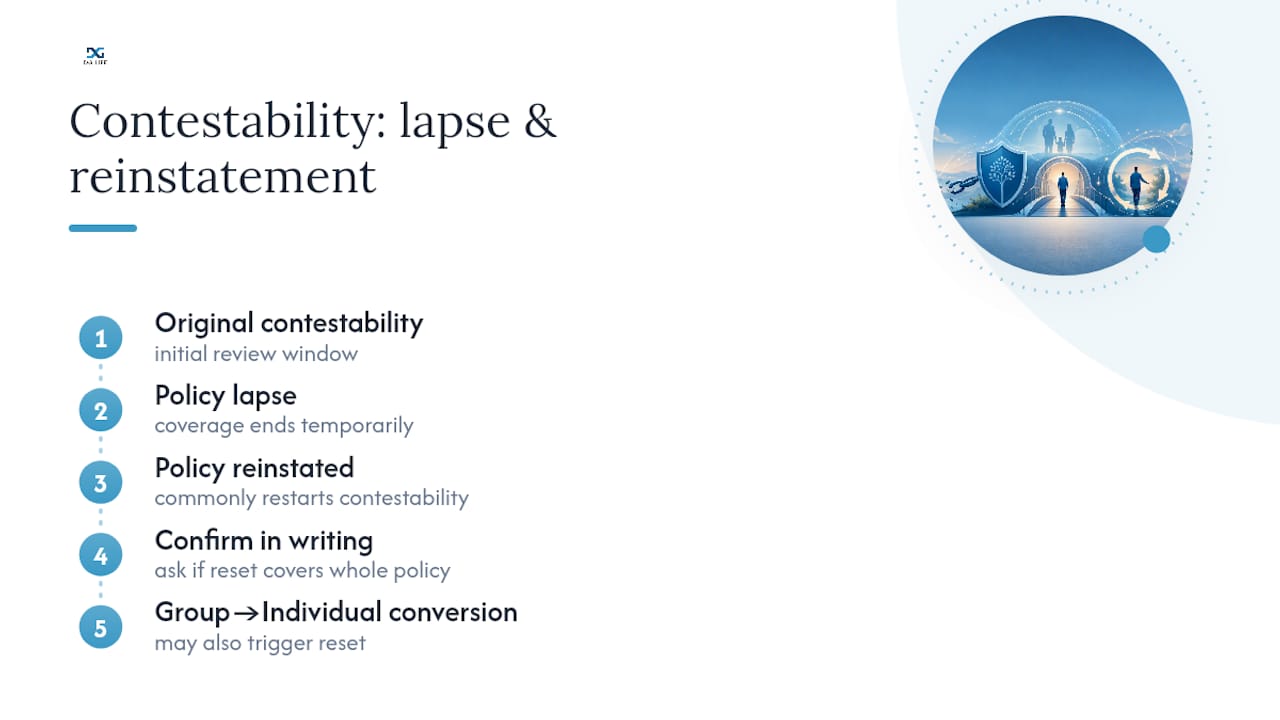
Reinstating a lapsed policy commonly restarts the contestability period, meaning you're back to a fresh review window even if you'd already cleared it once, MoneyGeek confirms. Before signing reinstatement paperwork, confirm in writing whether the new contestability clock applies to the entire policy or only to the reinstated portion. Group-to-individual conversions can trigger similar resets, so read the conversion terms closely.
How Providers Reduce Contestability Risk for Clients
Some companies work with multiple A-rated carriers to match applicants with policies suited to their actual health history, including no-medical-exam options that reduce disclosure gaps upfront. Accurate applications are the single best defense against a contested claim later. Living benefits riders, which let policyholders access funds while still alive during a qualifying illness, get documented the same way: clearly, in writing, at the time of issue.
A Broker's Take on Avoiding Contestability Trouble
The applications that cause problems later are rarely dramatic lies. They're small omissions people didn't think mattered. Answer every health question fully, report any diagnosis change to your carrier promptly, and get written confirmation whenever you update your file. That paper trail is what protects your beneficiaries.
— Dev
Get Ahead of Contestability Before You Need To
Everything above points to the same conclusion: contestability risk starts at the application, not at the claim. Choosing an independent broker is an alternative to guessing your way through a generic online quote form. Working with multiple A-rated carriers means your application gets matched to underwriting criteria that actually fit your health history, which is the single biggest factor in whether a claim sails through or gets flagged two years later.
If you're shopping for coverage or worried about a health condition complicating your application, start with the life insurance comparison tables to see how carriers stack up on pricing and underwriting flexibility. Readers concerned about a serious illness down the road should also look at the living benefits guide, which explains how to access a portion of your death benefit tax-free while you're still alive. Getting an accurate quote takes minutes, and it's the first real step toward a policy that won't cause your family headaches later.
Where This Information Comes From
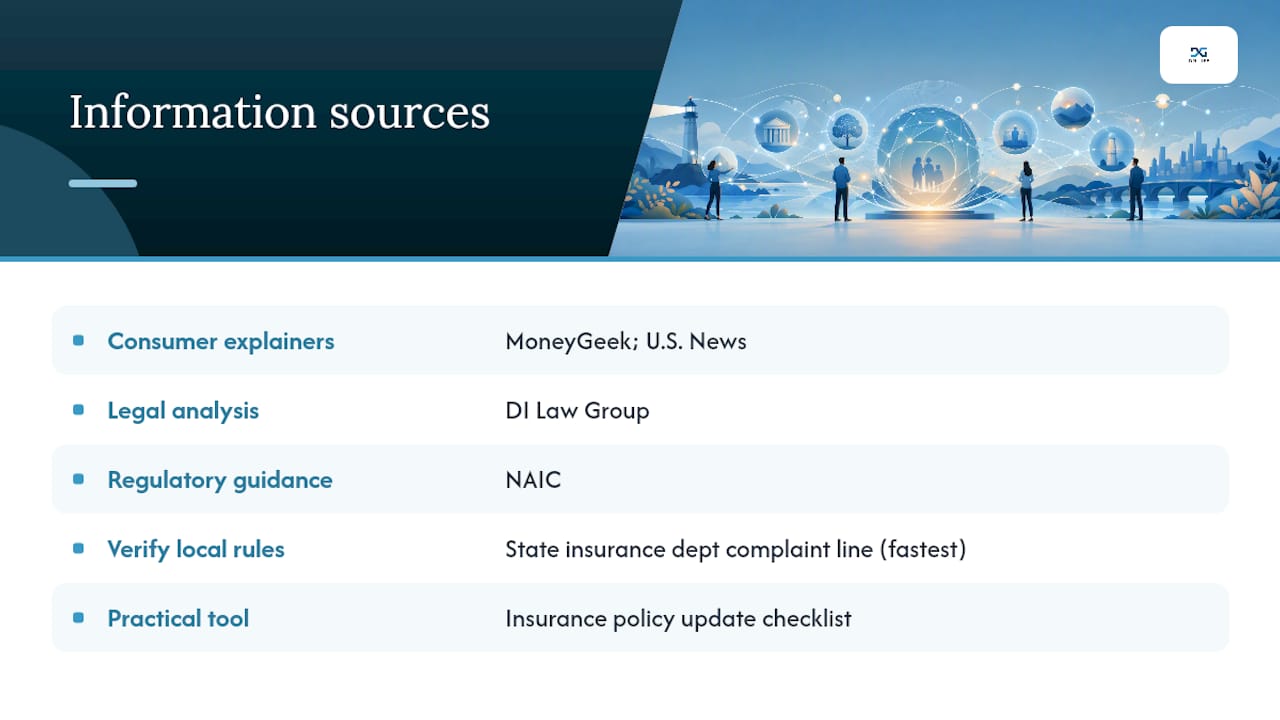
This article draws on consumer-facing explainers from MoneyGeek, U.S. News, and legal analysis from DI Law Group, along with regulatory guidance available through the NAIC. If you want to verify anything about your own state's rules, your state insurance department's consumer complaint line is the fastest path to an authoritative answer, and life events guidance like this insurance policy update checklist can help you stay ahead of disclosure gaps.
This article is general information, not a substitute for advice from a qualified financial advisor. Consult a qualified financial professional about your own circumstances before acting on anything here.
Sources
- What Is the Life Insurance Contestability Period? (MoneyGeek)
- Life Insurance Contestability Period (U.S. News)
- Life Insurance Contestability Period Denials: What Insurers Can Investigate and What They Cannot (DI Law Group)
FAQ
Can life insurance be denied after 2 years?
Generally no, except in cases of proven fraud or unpaid premiums, since the policy typically becomes incontestable once the two-year window closes.
How long is the grace period on a $500,000 level term life insurance policy?
Grace periods for missed premium payments typically last about a month regardless of the death benefit amount, though this is separate from the contestability period and set by the individual policy contract.
What is the 3-year rule for life insurance?
There's no universal "3-year rule" in life insurance; most contestability clauses run two years, though some suicide clause exclusions extend to three years depending on the carrier and policy.
Can a death claim be rejected after 3 years?
Once the contestability period has passed, which is typically two years, an insurer generally cannot reject a claim over application misstatements, though fraud and unpaid premiums remain valid grounds for denial at any time.