

An annuity pays guaranteed income to you while you're alive. Life insurance pays a death benefit to the people you leave behind. If your priority is not outliving your money in retirement, an annuity fills that gap. If your priority is protecting dependents or passing on wealth, life insurance does that job, and many households in Dallas-Fort Worth and across the country end up owning both.
TL;DR:
- Deferred annuities typically lock in principal for six to ten years with surrender charges of 7% to 10% in the first year, discouraging early withdrawals.
- Variable annuities can carry annual fees up to 3%, often layered with sub-account charges and income riders, which erodes returns over decades.
- Life insurance proceeds are generally income-tax-free for beneficiaries, whereas annuity earnings are taxable as ordinary income upon withdrawal.
- Combining life insurance and annuities is common among near-retirees, with life insurance protecting estate value and annuities providing guaranteed income streams.
Table of Contents
- Life Insurance vs. Annuity at a Glance
- What Is Life Insurance and How Does It Work?
- What Is an Annuity and How Does It Pay Out?
- How Do Fees, Liquidity, and Taxes Actually Compare?
- How Do You Decide Between Life Insurance and an Annuity?
- What Are the Biggest Risks and Misconceptions?
- Do People Actually Buy Both?
- How Does a Licensed Broker Apply This in Practice?
- What Actually Matters When Choosing Between These Two
- Get a Suitability Conversation Started With a Licensed Life Insurance Broker
- Sources
- FAQ
Life Insurance vs. Annuity at a Glance
I've sat across the table from families who thought these two products were interchangeable. They aren't. One is built to guard against dying too soon and leaving people without income. The other guards against living so long that savings run dry. That distinction, laid out by the Insurance Information Institute, shapes everything else about how each product works.
Here's how they stack up on the questions that actually matter to you:
- Primary purpose: Life insurance replaces income or pays off debts after death. Annuities convert a lump sum into predictable income while you're still alive.
- When money moves: Life insurance pays out on death (or, with living benefits, during a qualifying illness). Annuities typically pay out on a schedule you choose, starting immediately or years later.
- Typical buyer: Life insurance skews toward breadwinners, parents, and anyone with dependents or debt. Annuities skew toward people within a decade of retirement who want a pension-like income stream.
- Tax snapshot: Life insurance death benefits are usually income-tax-free to beneficiaries. Annuity earnings are taxed as ordinary income when you withdraw them, according to IRS guidance.
That last point catches people off guard almost every time. You can put $100,000 into an annuity and $100,000 into a life insurance policy, and the IRS treats the money that comes out of each one completely differently.
What Is Life Insurance and How Does It Work?
Life insurance works on a simple premise: you pay premiums, and if you die while the policy is active, your beneficiaries receive a death benefit. How you get there, though, splits into two very different paths.
Term life insurance covers you for a set period, usually 10 to 30 years, and it's the cheapest way to protect an income or a mortgage. If you have young kids or a spouse depending on your paycheck, term coverage matches the years you're actually needed most. It builds no cash value and expires at the end of the term.
Permanent life insurance (whole life, universal life, and indexed universal life, or IUL) never expires as long as premiums are paid, and it builds cash value alongside the death benefit. That cash value grows on a tax-deferred basis, and you can typically borrow against it or withdraw from it while you're alive.
A few mechanics matter here:
- Policy loans reduce your death benefit if unpaid, and they accrue interest, so a loan you never repay can quietly erode the payout your family expects.
- Withdrawals up to your basis (what you've paid in premiums) generally come out tax-free; amounts above that are taxed as income.
- Death benefits pass to named beneficiaries, and per IRS rules, that money is generally not counted as taxable income to them, with limited exceptions such as policies sold for value.
Pro Tip: If you're evaluating cash-value life insurance, ask the agent to show you the guaranteed column of the illustration, not just the projected one. Guaranteed numbers assume the worst; projected numbers often assume a rosy scenario that never fully materializes. You can compare structures side by side on DG Life Group's comparison page before deciding which one fits.
What Is an Annuity and How Does It Pay Out?
An annuity is a contract with an insurance company: you hand over a lump sum or a series of payments, and the insurer promises income back, either right away or years down the road.
Immediate annuities start paying out within a year of purchase, which makes them a fit for someone who just retired and needs income now. Deferred annuities delay payments while your money grows tax-deferred, which suits someone still working who wants to lock in future income today.
Inside those two categories, the risk profile changes depending on type:
- Fixed annuities guarantee a set interest rate and predictable payout, with no market exposure, as explained in detail in this Fixed vs Adjustable Mortgage: Which Fits Your Timeline? comparison.
- Fixed-indexed annuities link returns to a market index, like the S&P 500, with a floor that protects against loss but caps how much upside you capture.
- Variable annuities invest directly in sub-accounts similar to mutual funds, so your payout can rise or fall with the market, and they carry the highest fee structures of the three.
When it's time to collect, you choose a payout structure: lifetime income (payments for as long as you live, even if the account runs to zero), period certain (payments for a fixed number of years), or joint life (payments that continue for a surviving spouse). Each option trades monthly payout size for how long guaranteed income lasts.
On taxes, growth inside a non-qualified annuity is tax-deferred until you withdraw it, and then earnings are taxed as ordinary income, not capital gains. Pull money out before age 59½ and you'll typically face a 10% early-withdrawal penalty on top of regular income tax, according to FINRA guidance on early distributions. The NAIC's buyer's guide walks through these mechanics in more detail, including how surrender periods interact with your ability to access funds early.
How Do Fees, Liquidity, and Taxes Actually Compare?
The two products diverge sharply once you look past the sales brochure and into the fine print.
Liquidity favors life insurance, especially term. You can cancel a term policy anytime with no penalty beyond losing coverage. Cash-value policies let you tap funds through loans or withdrawals. Deferred annuities, by contrast, often lock up your principal for six to ten years through surrender charges, and breaking the contract early can cost you a meaningful percentage of your balance.
Beneficiary treatment differs too. Life insurance proceeds generally reach beneficiaries income-tax-free. Annuity death benefits, depending on the contract and whether it's qualified or non-qualified, can leave a beneficiary owing ordinary income tax on the growth portion, per IRS rules.
Fees and riders hit variable annuities hardest. Mortality and expense charges, sub-account fees, and optional income riders can stack up to 2% to 3% annually, a drag that compounds against you over decades. FINRA has flagged these products for suitability reviews precisely because the fee layering is easy to miss until you're locked in.
Guarantees on either product are only as strong as the insurer standing behind them. A "guaranteed" lifetime income rider means nothing if the carrier can't pay claims, which is why working with a broker who places policies across dozens of A-rated carriers, rather than a single captive insurer, matters more than the marketing on any one product.

How Do You Decide Between Life Insurance and an Annuity?
Start with the goal, not the product. Ask yourself what you're actually trying to protect against: dying too soon and leaving people short, or living long enough to outlast your savings. From there, work through this checklist.
- Identify your primary need. Do you need an income floor in retirement, a legacy for heirs, or tax-deferred growth on money you won't touch for years?
- Weigh your age and health. Younger, healthier buyers usually get the best term life pricing. Older buyers closer to retirement often find annuities more relevant because the income horizon is shorter and more certain.
- Count your dependents and debts. A mortgage, a spouse without independent income, or kids still in school all point toward life insurance first.
- Check your other retirement income. If Social Security and a pension already cover your basic expenses, an annuity may be redundant. If there's a gap, it may fill it well.
- Consider your tax bracket and liquidity needs. Money you might need in an emergency shouldn't go into a product with a seven-year surrender charge.
When you talk to a broker or agent, ask directly: What's the surrender period, and what does early withdrawal cost me? How is the agent compensated, through commission or fee? What guarantees does this product actually promise, and what happens if the insurer's rating drops? The NAIC's independent buyer's guide lists similar questions, and answers should come without hesitation.
Pro Tip: If an agent can't clearly explain the surrender schedule year by year without checking a script, that's a signal to get a second opinion before signing anything.
What Are the Biggest Risks and Misconceptions?
Deferred annuities almost always come with surrender charges, often starting around 7% to 10% in year one and declining to zero over six to ten years. Withdraw more than the free amount during that window, and you pay the penalty on top of any tax owed.
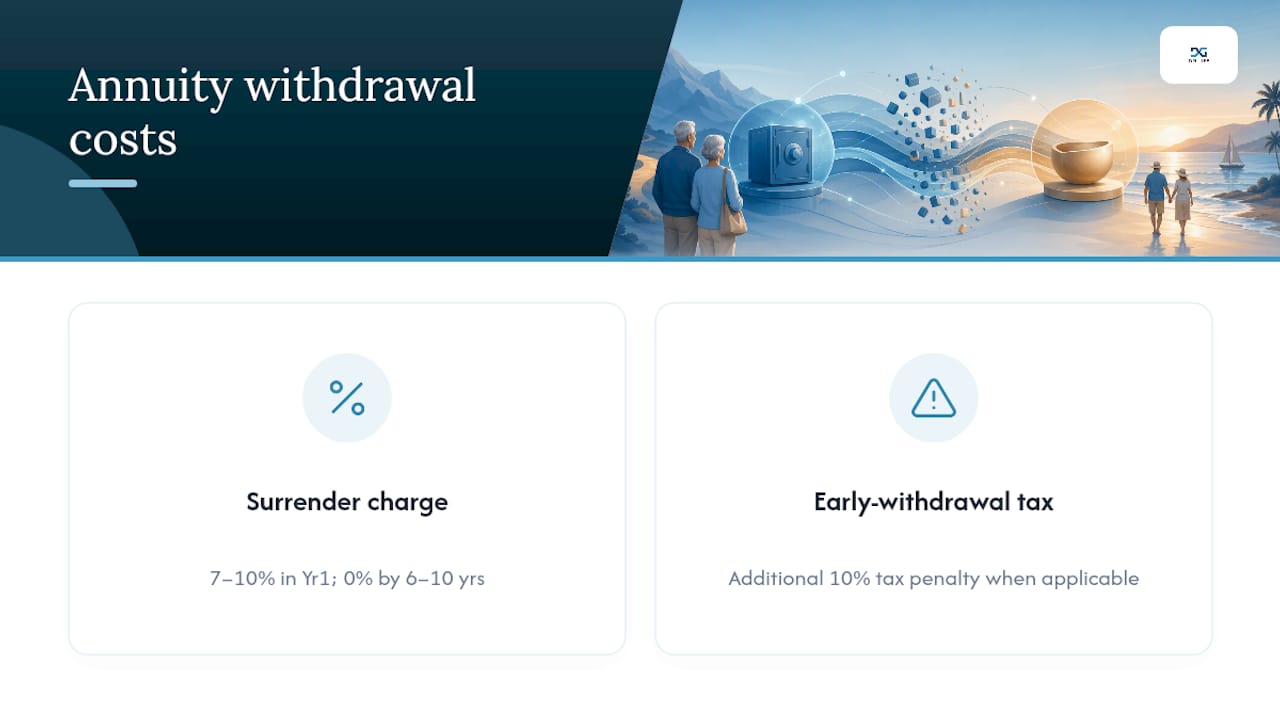
Variable annuities compound the problem with layered fees that quietly erode returns over a couple of decades, which is exactly why FINRA requires suitability documentation before these products are sold. A common misconception is that annuitizing is mandatory. It isn't, and industry data suggests most owners never convert their contract into a lifetime income stream at all, using it instead for tax-deferred growth. Another trap: assuming annuity death benefits pass tax-free like life insurance. They don't generally; the earnings portion may be taxable to your beneficiary.
Do People Actually Buy Both?
They do, and it's often the smarter move rather than an either-or decision.
- Young families typically buy affordable term life insurance to cover dependents while directing retirement savings into 401(k)s or IRAs, holding off on annuities until closer to retirement.
- Near-retirees often layer a deferred or immediate annuity for guaranteed income on top of a permanent life policy that protects estate value for heirs. This pairing addresses sequence-of-returns risk by covering essential expenses with guaranteed income instead of market withdrawals.
- Estate planners use permanent life insurance to create tax-favored wealth for heirs while an annuity supports a surviving spouse's day-to-day income, a structure that also matters for pension lump-sum decisions.
How Does a Licensed Broker Apply This in Practice?
A broker's job is to match products to your actual numbers, not a generic script. At DG Life Group, that means checking living-benefit riders and no-exam options against your health history, then comparing pricing across more than 30 A-rated carriers instead of pushing a single insurer's product. Before a suitability conversation, have your age, health history, income sources, and dependents on hand. Reach out when your health history is complicated, when estate planning is part of the picture, or when living benefits, access to part of your death benefit while critically ill, matter to your situation.
What Actually Matters When Choosing Between These Two
Most people overcomplicate this decision by treating it as a product comparison when it's really a sequencing question. Cover the people who depend on your income first, with life insurance, because that risk is immediate and irreversible if you skip it. Then look at whether Social Security, pensions, and savings leave an income gap in retirement, and consider an annuity only if that gap is real and specific. Buying an annuity because it sounds safe, without identifying the exact income shortfall it's meant to fill, is how people end up paying surrender charges to escape a product they never needed. Verify tax claims against the NAIC buyer's guide and IRS rules before signing anything, and if you're unsure which path fits, a suitability conversation with a licensed broker costs you nothing but a little time.
— Dev
Get a Suitability Conversation Started With a Licensed Life Insurance Broker
Working with an independent broker helps you avoid guessing which of dozens of carriers fits your health and budget. You can get access to multiple A-rated carriers compared side by side, with no-medical-exam options that can potentially put coverage in place quickly.

Whether you need term coverage to protect your family, a permanent policy with living benefits for added flexibility, or help thinking through where an annuity might fit alongside your life insurance, the process starts with a real conversation, not a generic quote form. If a health condition has made coverage feel out of reach, DG Life Group's approach to health conditions is worth a look before you assume you'll be declined. Compare current pricing on term, whole, and universal life plans, or visit the main site to start a suitability conversation and get matched with the carrier and policy structure that actually fits your situation.
This article is general information, not a substitute for advice from a qualified financial advisor. Consult a qualified financial professional about your own circumstances before acting on anything here.
Sources
- IRS — Life insurance and disability insurance proceeds FAQ
- NAIC — Buyer's Guide to Fixed Deferred Annuities
- Insurance Information Institute — How are annuities different from life insurance?
- FINRA — Notice to Members (variable insurance products guidance)
FAQ
What did Warren Buffett say about annuities?
Buffett has generally criticized high-fee, complex financial products for eroding investor returns over time, a concern that aligns with regulatory warnings about variable annuity fees from FINRA. He hasn't endorsed annuities as a core recommendation, favoring low-cost index investing for most savers.
How much will a $100,000 annuity pay monthly?
Monthly payout depends on your age, gender, the payout option chosen (lifetime vs. period certain), and current interest rates, so no single figure applies to everyone. A licensed broker or the NAIC's buyer's guide can walk you through how insurers calculate quotes for your specific age and contract type.
What is the biggest disadvantage of an annuity?
Illiquidity is the most common complaint: deferred annuities carry surrender charges that can run 7% to 10% or more if you withdraw early, on top of the 10% IRS early-withdrawal penalty before age 59½. High fees on variable products compound this drawback over time.
What does Warren Buffett say about life insurance?
Buffett hasn't made life insurance a signature topic of his public commentary the way he has with annuities and fees, but he has spoken favorably about insurance as a business model built on pooling risk. For individual buyers, the core case for life insurance remains straightforward: it replaces income and protects dependents if you die unexpectedly.
What's the real difference between life insurance and an annuity?
Life insurance pays a death benefit to your beneficiaries, generally income-tax-free, while an annuity pays income to you while you're alive, with earnings taxed as ordinary income upon withdrawal. One protects against dying too soon; the other protects against living too long, as the Insurance Information Institute frames it.