
Yes, most people with Crohn's disease can get life insurance. Approval and price depend far less on the diagnosis itself than on how long you've been stable, how well your treatment controls flares, and what your recent labs and colonoscopy show. Well-managed cases often qualify for standard or near-standard term or whole life rates. Recent flares, surgeries, or complications usually push you toward simplified or guaranteed-issue coverage until you build a longer track record of documented control.
TL;DR:
- Well-managed Crohn's disease patients with stability over one to two years often qualify for standard or near-standard life insurance rates.
- Underwriters focus on disease control, recent labs, and colonoscopy findings rather than diagnosis date or location of disease.
- Fully underwritten policies suit those with mild, stable Crohn's, while simplified or guaranteed issue options are better for recent flare or complications.
- Applying after a longer period of remission and providing detailed medical documentation improves approval chances and lowers premiums.
- A broker can help find the best insurer, especially if prior applications were declined or rated high, by matching your current condition with carrier guidelines.
Table of Contents
- What Insurers Look For When You Apply
- Policy Types And Which Ones Fit Your Crohn's Profile
- How To Improve Your Approval Odds And Lower Your Premium
- The Application Process: What Happens After You Apply
- If You're Declined Or Rated High: Realistic Alternatives
- How DG Life Group Helps Applicants With Crohn's Disease
- What A Crohn's Diagnosis Means For Your Beneficiaries
- Where Life Insurance Fits Into Your Broader Financial Plan
- Common Exclusions And Limitations To Watch For
- Editorial Take: Why Timing Beats Diagnosis Every Time
- Ready To Get A Real Quote For Crohn's Disease Life Insurance
- Sources
- FAQ
What Insurers Look For When You Apply
An underwriter reviewing a Crohn's disease life insurance application isn't grading you on the diagnosis. They're grading you on control. That distinction changes everything about how you should prepare your application.
The diagnosis date matters, but mostly as a reference point. An underwriter wants to know how long you've had the disease and whether your risk has trended up or down since. Location and extent of the disease also factor in. Isolated ileitis generally reads as lower risk than extensive colonic involvement or disease that has spread to multiple segments of the digestive tract.
Disease activity carries the most weight. Underwriters ask about flare frequency over the past two to five years, any hospitalizations, and complications like fistulas, strictures, or abscesses. A single flare three years ago with nothing since reads very differently than three flares in the last eighteen months.
Surgical history gets close scrutiny too. A bowel resection isn't automatically disqualifying, but the underwriter wants to know the outcome. Did it resolve the complication, or has disease activity continued afterward?
Treatment history tells its own story. Being on a biologic like infliximab or omalizumab doesn't automatically raise your rate. In many cases, it signals the opposite: you're actively managing a chronic condition rather than leaving it untreated. Chronic high-dose steroid use, on the other hand, tends to worry underwriters because it often points to disease that hasn't been fully controlled by other means.
Underwriters also want objective evidence, not just your self-report. Expect requests for:
- Recent colonoscopy and biopsy reports showing mucosal healing or ongoing inflammation
- Lab markers such as C-reactive protein or fecal calprotectin
- Imaging studies if strictures or fistulas were ever diagnosed
- An Attending Physician Statement (APS) pulled directly from your gastroenterologist
Non-IBD factors still matter. Smoking status, BMI, and any other chronic conditions get layered into the overall risk picture, sometimes more heavily than the Crohn's diagnosis itself.
Most carriers look for a stability window of one to two years without a major flare, hospitalization, or medication change before offering their best available rates. Cross that threshold and your options open up considerably.
Policy Types And Which Ones Fit Your Crohn's Profile
Not every policy type suits every stage of disease management. Matching the right product to your current health picture saves you money and frustration.
-
Fully underwritten term or whole life. This is the target for anyone with mild, well-controlled Crohn's disease and at least a year or two of stability. It requires the most documentation, including an APS and possibly lab work, but it delivers the lowest premiums and the highest coverage limits. If your gastroenterologist can point to sustained remission, this route is worth pursuing first.
-
Simplified issue policies. These skip the medical exam and rely on a health questionnaire plus a records check. Approval comes faster, often within days rather than weeks, but premiums run higher than fully underwritten policies for the same coverage amount. Simplified issue makes sense if you need coverage quickly or your case is borderline for traditional underwriting.
-
Guaranteed issue policies. No health questions, no medical exam, guaranteed approval within an age range. The tradeoff is real: coverage caps out low, often in the $5,000 to $25,000 range, and most policies apply a graded death benefit for the first two to three years, meaning a natural-cause death pays out only premiums plus interest rather than the full benefit. This product is built for final expense coverage, not income replacement.
-
Employer or group coverage. If your job offers group life insurance, take it. Basic amounts typically require no individual underwriting, which makes this one of the most accessible forms of protection for people managing chronic conditions. It rarely covers everything you need on its own, but it's a solid floor.
-
Riders and living benefits. Some policies let you add a chronic illness or living benefits rider, giving you access to a portion of the death benefit while you're still alive if you develop a qualifying serious condition. For anyone with a history of IBD complications, this feature deserves a serious look rather than an afterthought.
How To Improve Your Approval Odds And Lower Your Premium
Getting a better rate on Crohn's disease life insurance is less about finding a lenient carrier and more about walking in with a stronger file. A few deliberate moves before you apply change the outcome.
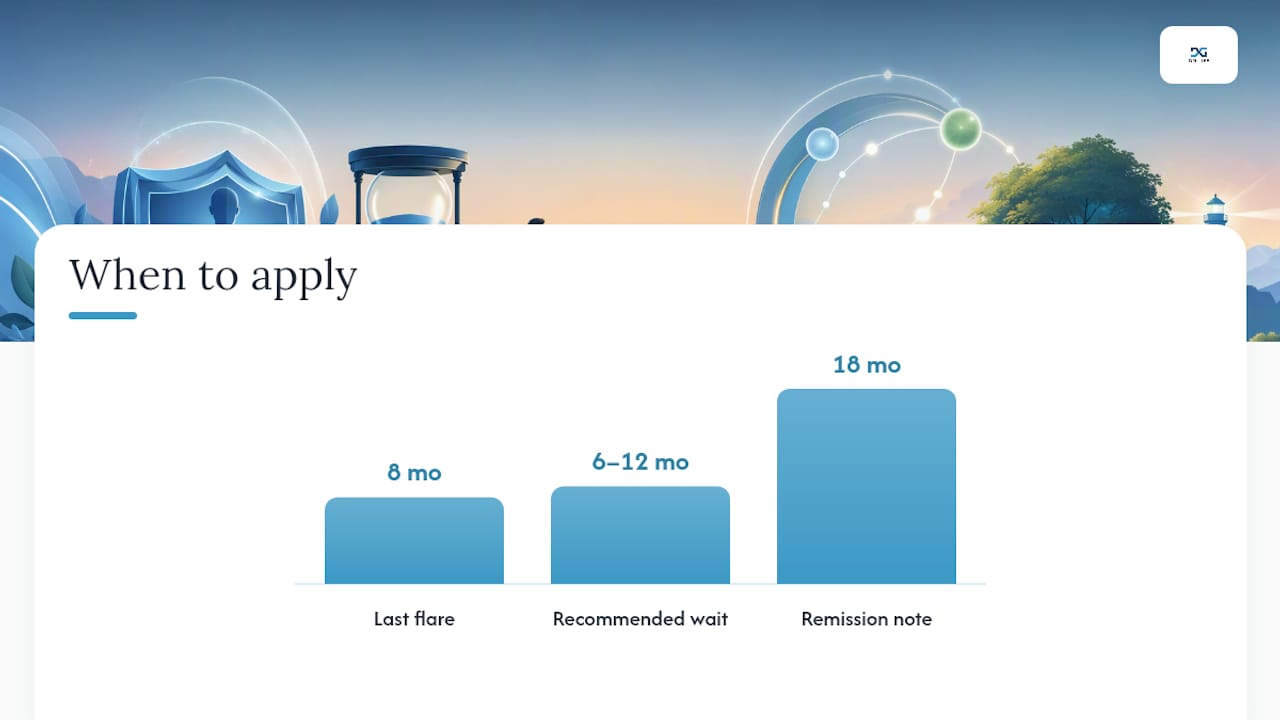
Start with time. Underwriters want to see a stretch without a flare, hospitalization, or surgery. If you had a flare eight months ago, waiting another six to twelve months before applying often moves you into a better rate class. Applying too early, while your file still shows recent instability, tends to lock in a worse offer that's hard to renegotiate later.
Build your documentation before you apply, not after the underwriter asks. Useful records include:
- The original diagnosis note, including disease location and severity at diagnosis
- Your two most recent colonoscopy and biopsy reports
- A summary of hospitalizations, surgeries, and any complications
- A current medication list with start dates and dosages
- Recent lab results, particularly inflammatory markers
Ask your gastroenterologist for a short letter summarizing your current control and prognosis. A one-page note that says your disease has been in remission for eighteen months on a stable biologic dose carries real weight with an underwriter, and it often resolves questions faster than back-and-forth record requests.
Lifestyle factors compound with disease factors. Quitting smoking, keeping your weight in a healthy range, and staying consistent with your medication schedule all signal lower overall risk, and underwriters read consistency as a proxy for control.
Pro Tip: Don't apply to just one carrier and accept whatever you're offered. Underwriting appetite for Crohn's disease varies significantly between insurers, and an independent broker who works with impaired-risk cases can shop your file across multiple companies at once, often landing a better class than the first quote you receive.
The Application Process: What Happens After You Apply
The path from quote to policy typically follows a predictable sequence, and knowing it in advance keeps you from being caught off guard.
-
Get a quote. This initial number is based on self-reported health information and is not final. Treat it as a starting point, not a guarantee.
-
Submit the full application. You'll disclose your Crohn's diagnosis, treatment history, medications, and any hospitalizations or surgeries here in detail.
-
Complete a paramedical exam, if required. This usually involves blood pressure, height and weight, and a blood or urine sample. Many simplified issue products skip this step entirely, while fully underwritten policies almost always require it.
-
Wait for the APS request. The insurer contacts your gastroenterologist directly for your complete medical records. This step is frequently the slowest part of the process, since physician offices can take one to three weeks to respond to records requests.
-
Underwriting review and decision. An underwriter combines your application, exam results, and APS to assign a rate class, or in some cases request additional information before deciding.
Total timeline for fully underwritten Crohn's disease life insurance typically runs two to eight weeks. Simplified issue can resolve in days. The biggest variable is usually how quickly your specialist's office responds to the records request, so calling ahead to ask them to expedite it is worth the effort. If the underwriter comes back asking for clarification or additional records, respond quickly and specifically. Vague or delayed answers tend to stretch the timeline further and can sometimes push a borderline case toward a higher rate class by default.
If You're Declined Or Rated High: Realistic Alternatives
A decline or a high table rating isn't the end of the road. It's a signal to shift strategy, not give up on coverage.
- Guaranteed issue policies remain available regardless of your Crohn's history, though coverage caps low and a graded death benefit applies for the first two to three years. These work well for final expense planning but poorly for replacing income.
- Simplified issue and accidental death products offer a middle ground, with faster approval than full underwriting and fewer health questions than you might expect.
- Employer-sponsored group life deserves a second look if you skipped it during open enrollment. Minimal underwriting makes it one of the most reliable fallback options for anyone managing a chronic condition.
- Reapplying after a longer stability window often produces a materially better offer. A carrier that declined you at six months post-flare may approve you at eighteen months with the same medication regimen.
- Appealing with new evidence, such as a fresh gastroenterologist letter or updated labs, can sometimes overturn an initial decision without a full reapplication.
- Working with a broker who specializes in impaired-risk cases puts your file in front of carriers whose underwriting guidelines are genuinely built to accommodate chronic illness, rather than a general-market insurer guessing at your risk.
If budget or coverage limits force a choice, prioritize based on what would create the biggest financial gap for your family. Income replacement for dependents usually outweighs final expense coverage if you have to pick one first.
How DG Life Group Helps Applicants With Crohn's Disease
Placing coverage for someone with Crohn's disease is a matching problem. Every carrier weighs disease severity, treatment history, and stability differently, and the gap between the best and worst offer for the same applicant can be substantial. An independent group can work across many A-rated carriers to find those whose underwriting guidelines fit your current health picture, including no-medical-exam options when a full paramedical exam isn't practical or desired.
For clients managing serious IBD complications, living benefits are worth discussing directly with an advisor. These riders let you access part of your death benefit while you're still alive if you develop a qualifying critical or chronic illness, which can matter considerably if a future complication requires expensive treatment.
Before a consultation, gather your diagnosis date, current medications, and any recent colonoscopy results. That's usually enough for an initial carrier match and a realistic timeline estimate.
What A Crohn's Diagnosis Means For Your Beneficiaries
A life insurance policy pays your beneficiary the full death benefit once the policy is in force, regardless of whether Crohn's disease later contributed to a health decline, as long as the original application was truthful. The disease itself doesn't create an ongoing risk to the payout once underwriting is complete.
The real risk to beneficiaries shows up earlier, at the application stage. Misrepresenting your diagnosis date, flare history, or medication use on the application can give an insurer grounds to contest a claim during the contestability period, which is a defined period from issue. This is why accuracy on the initial application matters more than trying to present your case in the best possible light.
Graded death benefit policies carry a different consideration worth flagging for beneficiaries specifically. If a policyholder dies of natural causes within the first two to three years of a guaranteed issue policy, the beneficiary receives only the premiums paid plus interest, not the full face amount. Death by accident is typically paid in full even during the graded period. Anyone relying on a guaranteed issue policy as their primary coverage should make sure beneficiaries understand this distinction, since it can create a significant gap between expected and actual payout in the early years.
Where Life Insurance Fits Into Your Broader Financial Plan
Life insurance for someone with Crohn's disease isn't just a health-contingency purchase. It's a piece of a larger plan that has to account for medical costs that can spike unpredictably.
Biologics, hospitalizations, and surgeries carry real out-of-pocket costs even with good insurance, and a chronic illness rider or living benefit attached to a life policy can function as a secondary emergency fund for exactly those moments. That's a different use case than the death benefit itself, and it's worth discussing with whoever helps you plan your coverage.
Term life tends to fit the income-replacement need most people have during their working years and family-raising years. Permanent policies, including whole life, build cash value over time and can serve estate planning or long-term financial goals once term coverage needs fade. Which one makes sense depends on your age, dependents, and how likely you think you are to need liquidity from a living benefit down the road.
Because Crohn's disease can involve future medical uncertainty, locking in coverage while you're in a stable period, rather than waiting, tends to protect both your rate and your options. Rates only get harder to secure after a new flare or complication resets your underwriting file.
Common Exclusions And Limitations To Watch For
Crohn's disease rarely triggers an outright exclusion clause on a standard life insurance policy, but a few limitations show up often enough to check for before you sign.
Graded death benefit periods are the most common limitation, and they apply almost exclusively to guaranteed issue products rather than fully underwritten term or whole life. During that two to three year window, a natural-cause death pays out reduced benefits, so read the graded period terms carefully before choosing this route as your only coverage.
Table ratings function as a cost limitation rather than an exclusion. A table-rated policy still pays the full face amount, but you pay a higher premium for the same coverage a healthier applicant would get at standard rates. Some carriers also apply flat extra charges, a fixed additional premium on top of your base rate for a set number of years, tied specifically to recent surgery or complication history.
Contestability clauses aren't unique to Crohn's disease, but they matter here because of how much medical history an application involves. Any material misstatement about your diagnosis, treatment, or flare history discovered within the first two years can jeopardize a claim. Full disclosure at application time protects your beneficiaries far more than optimistic omission does.
Editorial Take: Why Timing Beats Diagnosis Every Time
Most guidance on life insurance for chronic conditions treats the diagnosis as the headline risk factor. That framing is backwards. Two applicants with identical Crohn's diagnoses, one two years post-flare with clean labs, one six months out from a bowel resection, will get wildly different offers from the same carrier. The diagnosis is the constant. Timing and documentation are the variables that actually move your rate.
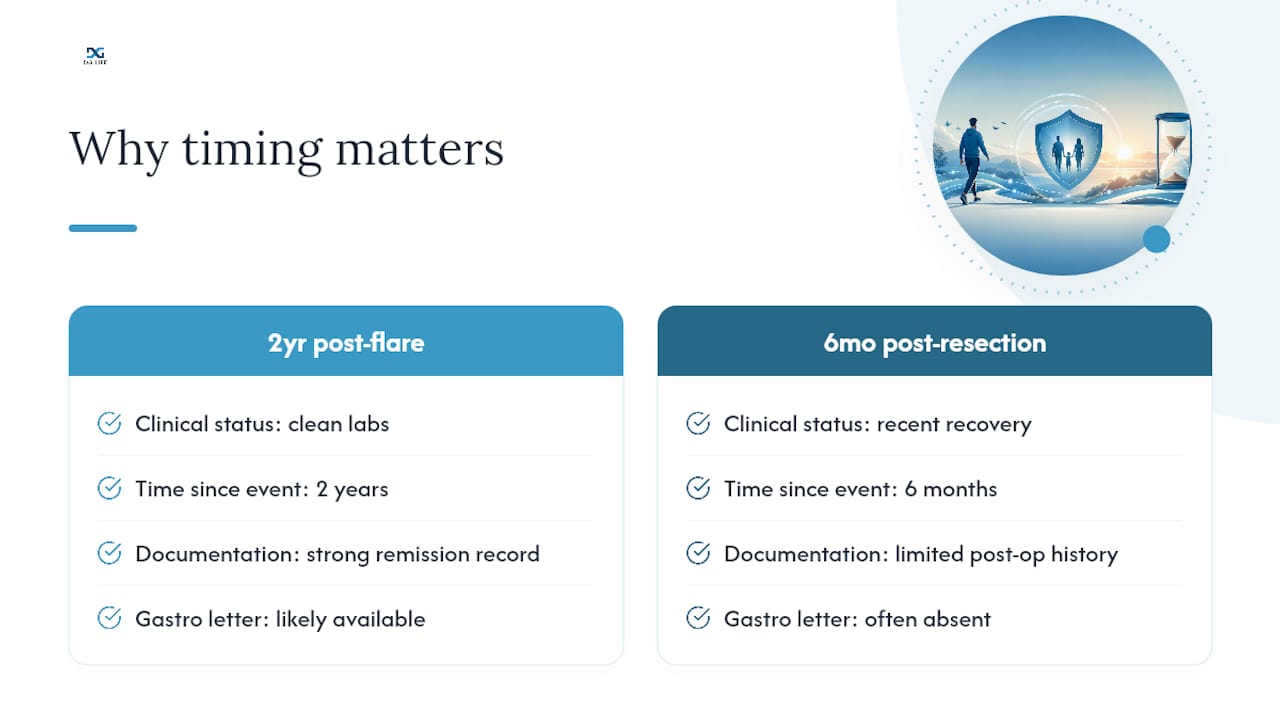
The advice that gets underweighted is the waiting period. Applicants often rush to apply the moment they feel stable, without realizing that another six to twelve months of documented remission could shift them into a meaningfully better rate class. Insurance isn't going anywhere. Your rate class might.
What deserves more attention than it gets: the gastroenterologist letter. A well-written physician summary does more underwriting work than any amount of self-reported optimism on an application form, and most applicants never think to ask for one.
— Dev
Ready To Get A Real Quote For Crohn's Disease Life Insurance
Independent advisors exist for exactly this situation: applicants whose health history makes a standard online quote unreliable and whose best option isn't obvious without someone who knows how multiple carriers actually underwrite chronic illness. Instead of guessing which insurer might approve you, an advisor matches your specific diagnosis history, medication record, and stability window against carriers whose guidelines actually fit your file, including no-medical-exam paths when that's the better route.
Before your first call, pull together your diagnosis date, current medications, and your most recent colonoscopy results if you have them handy. That's typically enough to start carrier matching and give you a realistic timeline. If serious complications are part of your history, ask specifically about the living benefits available on the policies you're matched with, since accessing part of your death benefit while alive can matter more than the face amount itself in a real medical crisis. Explore your current options for health conditions or get instant term rates to see where your file likely lands before committing to a full application.
Sources
For medical background on Crohn's disease, the NIDDK and Mayo Clinic offer reliable clinical overviews. For underwriting specifics, see the DG Life Group guide to health condition coverage and the broader life insurance guide.
This article is general information, not a substitute for advice from a qualified financial advisor. Consult a qualified financial professional about your own circumstances before acting on anything here.
- Life insurance for Crohn's disease patients (MoneyGeek)
- Crohn's & Colitis Foundation: insurance support resources
FAQ
What Is The Average Life Expectancy For Females With Crohn's Disease?
Life expectancy varies too widely by disease severity, complications, and treatment response for a single reliable figure. Mayo Clinic notes that well-managed Crohn's disease has a limited impact on lifespan for most patients, with outcomes tied closely to how effectively the disease is controlled.
What Conditions Disqualify You From Life Insurance?
Very few conditions cause an automatic decline; most, including Crohn's disease, are priced based on severity and stability rather than refused outright. Carriers reserve outright declines mostly for very recent, severe, or unstable illness, and even then, guaranteed issue policies remain available.
Is Crohn's Considered A Permanent Disability?
Crohn's disease can qualify as a disability under federal disability programs if symptoms are severe enough to significantly limit major life activities, but many people with the condition work and function without meeting that threshold. Disability status is a separate legal determination from how a life insurance underwriter rates the condition.
Is Crohn's Classed As A Critical Illness?
Standard critical illness insurance policies typically list conditions like cancer, heart attack, and stroke, and Crohn's disease usually isn't included by default. Some chronic illness riders attached to life insurance policies, including options offered through DG Life Group's living benefits products, can extend coverage to serious IBD complications depending on the policy terms.
Recommended
- Life Insurance With Diabetes
- Life Insurance With Health Conditions
- Life Insurance With Asthma
- Life Insurance Pre-Existing Conditions
Created with BabyLoveGrowth to get recommended by Perplexity