

Simplified issue life insurance usually costs less and allows higher coverage limits, but only if you can answer a short health questionnaire honestly, and pass background checks. Guaranteed issue accepts almost anyone within an age range, no questions asked, but you pay more per dollar of coverage, get a smaller policy, and wait two to three years before the full death benefit kicks in for natural causes. If you're reasonably healthy, simplified issue is nearly always the better deal. If health problems have already closed other doors, guaranteed issue is the fallback worth understanding.
TL;DR:
- Simplified issue typically costs less and offers higher coverage limits than guaranteed issue, provided you pass a health questionnaire and background checks.
- Guaranteed issue accepts almost anyone within a certain age range but has smaller policies, higher premiums, and a waiting period of two to three years for full natural death benefits.
- The underwriting process for simplified issue involves answering brief health questions and verifying answers through prescription and MIB records, with immediate full coverage possible for healthy applicants.
- Applicants with serious, recent health issues or past declines should consider guaranteed issue, but healthy individuals should start with simplified issue to avoid unnecessarily higher costs.
Table of Contents
- Simplified Issue vs Guaranteed Issue at a Glance
- How Simplified-Issue Underwriting Actually Works
- How Guaranteed-Issue Life Insurance Works
- What Coverage Actually Costs: Sample Comparisons
- Who Should Choose Which Policy?
- Applying and What Happens Next
- Why Trust Dglifegroup on This Comparison
- A Broker's Honest Take on This Tradeoff
- Compare No-Exam Options Before You Settle for Guaranteed Issue
- Sources
- FAQ
Simplified Issue vs Guaranteed Issue at a Glance
The two products solve different problems, and the comparison usually comes down to how much certainty you need versus how much you're willing to pay for it.
- Medical exam/questions: Simplified issue asks a short health questionnaire; guaranteed issue asks nothing.
- Approval certainty: Simplified issue can decline you; guaranteed issue cannot, within its age brackets.
- Waiting period: Simplified issue often pays full benefits immediately; guaranteed issue typically imposes a 2 to 3 year graded period for natural death claims.
- Face amount: Simplified issue commonly runs $10,000 to $100,000; guaranteed issue is usually capped between $2,000 and $25,000.
- Premium direction: Guaranteed issue almost always costs more per $1,000 of coverage.
Consider three quick scenarios. A 58-year-old with well controlled high blood pressure and no hospitalizations will likely qualify for simplified issue at a reasonable rate. A 72-year-old managing stage 3 kidney disease may get declined for simplified issue and need guaranteed issue instead. A 65-year-old who was denied coverage twice due to a recent cancer diagnosis has almost no path except guaranteed issue or a graded whole life plan.
Myth to retire: guaranteed issue is not the cheap option. It's the accessible one. Consumer comparisons consistently show it costing more per dollar of coverage than simplified issue, because the insurer is pricing in risk it can't screen out.
How Simplified-Issue Underwriting Actually Works

"Simplified" refers to the process, not the scrutiny. You'll answer a health questionnaire, typically 5 to 15 questions covering things like recent hospitalizations, cancer history, tobacco use, and current prescriptions. There's no blood draw and no paramedical exam.
But the insurer isn't taking your word for it. Carriers routinely cross-check your answers against prescription history databases and the MIB (Medical Information Bureau), a shared record system insurers use to catch inconsistencies, according to Society of Actuaries research on simplified-issue underwriting. Some also pull driving records or past claims history.
- Coverage typically ranges from $10,000 to $100,000, occasionally up to $250,000 for healthier applicants.
- Full death benefit often applies from day one, no graded waiting period.
- Pricing sits between guaranteed issue and fully underwritten term or no-exam life insurance, which requires a medical exam but rewards you with the lowest rates.
Pro Tip: Answer every questionnaire item exactly as it applies, even minor ones. A prescription-history mismatch can trigger a rescission months into the policy, right when your beneficiaries need the payout most.
How Guaranteed-Issue Life Insurance Works
Guaranteed issue means exactly what it says. No medical questions, no exam, no possibility of a decline as long as you fall within the carrier's age brackets, usually somewhere between 50 and 85.
That guarantee comes at a structural cost. Insurers can't price individual risk, so they build in a graded death benefit: if you die from natural causes within the first 2 to 3 years, beneficiaries typically receive a refund of premiums paid plus a small percentage, not the full face amount, per comparisons of guaranteed versus simplified issue for seniors.
- Face amounts are modest, commonly in the lower coverage range typical for final-expense insurance.
- Accidental death is usually the exception. Most policies pay the full benefit immediately if death results from an accident, even during the graded period.
- These are widely marketed as final-expense coverage, sized to handle funeral costs and small remaining debts rather than income replacement.
What Coverage Actually Costs: Sample Comparisons
Price is where the two products diverge most sharply. One illustrative example from an industry comparison shows a 70 year old female non-smoker paying around $75 a month for a $10,000 simplified-issue policy, versus roughly $120 a month for the same $10,000 in guaranteed-issue coverage, according to Insurance Curator's senior life insurance comparison. That's a meaningful gap for identical face value, and it's typical of the pattern across carriers.
The graded benefit compounds that gap. If a guaranteed-issue policyholder dies of natural causes in year one, the payout might be limited to a premium refund rather than the full $10,000, effectively making the early years of the policy far less valuable than the sticker price suggests.
- Simplified issue: lower monthly cost, full benefit from the start, if you qualify.
- Guaranteed issue: higher monthly cost, reduced early payout, guaranteed acceptance.
- Get a personalized quote before assuming either number. Age, smoking status, and carrier all move the price meaningfully.
Who Should Choose Which Policy?
Run through this before you apply:
- Have you been declined for life insurance before, or diagnosed with a serious condition in the past two years? That pushes you toward guaranteed issue.
- Can you honestly answer "no" to major questions about cancer, heart disease, or recent hospitalization? Simplified issue is likely open to you, often at better rates.
- Do you need more than $25,000 in coverage? Guaranteed issue probably can't get you there; simplified issue can.
- Is your budget tight and your health uncertain? Some buyers layer a small guaranteed-issue policy for immediate final-expense needs alongside a larger simplified-issue policy where they qualify.
A healthy 60-year-old wanting $50,000 for a mortgage balance should try simplified issue first. Someone with stage 4 COPD needing burial coverage should go straight to guaranteed issue. A diabetic managing the condition well might qualify for simplified issue through a carrier that specializes in impaired-risk pricing.
Applying and What Happens Next
For simplified issue, expect to complete the questionnaire, then wait while the carrier runs prescription and MIB checks. Many applicants get a decision within days rather than the weeks a fully underwritten policy takes, per NerdWallet's overview of simplified-issue timelines. Guaranteed issue moves faster still: a short form, often approved immediately, with the graded period simply built into the contract from day one.
- Read the graded death-benefit wording carefully before signing.
- Check for exclusions and how accidental-death provisions are defined.
- Compare more than one carrier. Underwriting practices vary enough that shopping through an independent broker can change both your price and your odds of approval.
Pro Tip: Never assume you'll fail simplified-issue underwriting just because one carrier declined you. Standards differ enough between insurers that a second application can produce a completely different outcome.
Why Trust Dglifegroup on This Comparison
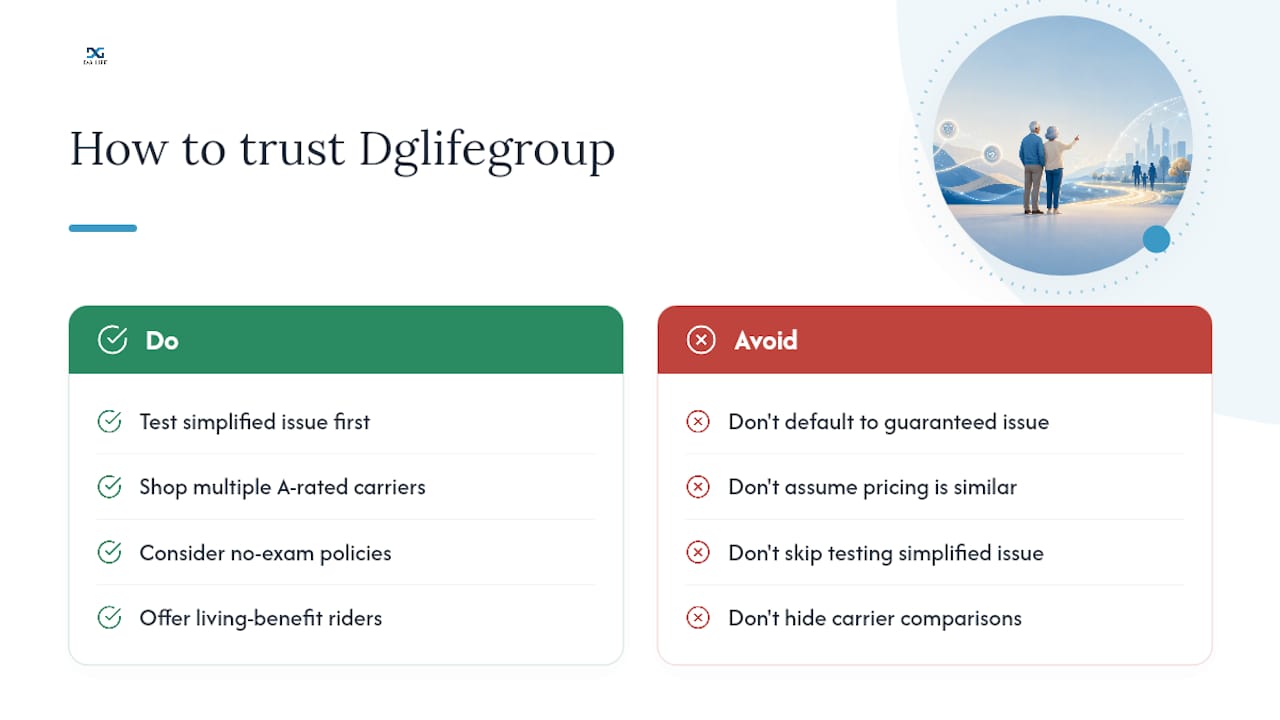
Comparing simplified-issue and guaranteed-issue options involves working with multiple A-rated carriers and includes considering no-exam policies and living-benefit riders that let clients access part of their death benefit while still alive. This article was written by Dev, a licensed insurance broker.
When a client's health history makes simplified issue a real possibility, we test it before defaulting to guaranteed issue, because the pricing difference is rarely small. When guaranteed issue turns out to be the only realistic path, we say so plainly and help find the best version of it.
A Broker's Honest Take on This Tradeoff
Most clients don't want the cheapest policy. They want their family covered without overpaying for certainty they didn't need. Get quotes for both before deciding. The gap in cost, and in what your beneficiaries actually collect, is usually bigger than people expect.
— Dev
Compare No-Exam Options Before You Settle for Guaranteed Issue
An independent broker can check simplified-issue eligibility across multiple A-rated carriers before assuming guaranteed issue is the only option, and often confirm which policies applicants actually qualify for quickly.

If you're not sure where you stand, three steps get you an answer fast: get a free instant quote, request a policy review if you already hold a guaranteed-issue plan and want to see if you now qualify for something better, or call to speak with an adviser about combining a small guaranteed-issue policy with a living-benefits option for broader protection. Start with the quote. It costs nothing to find out which door is actually open to you.
Sources
Key sources: the Society of Actuaries report on simplified-issue underwriting, Forbes Advisor's guide to guaranteed-issue pros and cons, and Insurance Curator's senior policy comparison.
This article is general information, not a substitute for advice from a qualified financial advisor. Consult a qualified financial professional about your own circumstances before acting on anything here.
- Simplified issue underwriting (Society of Actuaries research report)
- Whole life insurance for seniors: comparing guaranteed vs simplified issue — Insurance Curator
FAQ
What Does Simplified Issue Mean in Life Insurance?
Simplified issue means you apply by answering a short health questionnaire instead of taking a medical exam, and the insurer verifies your answers through prescription and MIB records before deciding.
What Does Guaranteed Issue Mean in Insurance?
Guaranteed issue means the insurer must accept you within a set age range regardless of health, with no questions and no exam, though it usually comes with a graded death-benefit waiting period.
What Does "Guaranteed Issue" Mean for Medicare?
For Medicare, guaranteed issue refers to specific rights that let you buy a Medigap policy without medical underwriting during certain enrollment windows or qualifying events, a different context from guaranteed-issue life insurance.
Is Guaranteed-Issue Life Insurance Worth It?
It's worth it mainly for applicants who've been declined elsewhere or manage a serious health condition, since the guaranteed acceptance comes with higher per-dollar premiums and lower face amounts, typically used for final expenses.
Can I Hold Both a Simplified-Issue and Guaranteed-Issue Policy?
Yes. Some buyers keep a small guaranteed-issue policy for immediate final-expense coverage while applying separately for a larger simplified-issue policy, and a broker can help structure that combination.