

Yes. Most stay-at-home parents should carry a standalone life insurance policy sized to replace household labor and childcare costs for as long as those costs stay high, typically until the youngest child is grown. A 20 to 25-year term policy, sized against real replacement costs and paired with living benefits or a no-exam option if you need speed, covers most families well. Your next move: run the numbers with a life insurance calculator or talk to an independent broker who can shop multiple carriers for you.
TL;DR:
- Stay-at-home parents should consider a 20 to 25-year term policy based on household contribution or future earnings, aligning with their youngest child's independence age.
- Coverage must reflect real replacement costs, including childcare, housekeeping, and incidental household expenses, which can total thousands of dollars monthly.
- Premiums for a $500,000 coverage can be modest for healthy, non-smoking parents in their mid-thirties, with age, health, and term length influencing the cost.
- Prioritize policies with living benefits and no-exam underwriting to ensure flexibility and faster approval, especially when coverage caps are based on the working spouse’s policy.
Table of Contents
- What A Stay-At-Home Parent's Work Is Actually Worth
- Two Ways To Size Your Coverage (With Real Numbers)
- Term, Whole, Or Something With Living Benefits?
- How Underwriters Look At A Non-Working Applicant
- What Coverage Actually Costs
- Your Shopping Checklist Before You Buy
- Why I Push Back On "Wait Until You Return To Work"
- Get A Quote Built Around What Your Family Actually Needs
- Sources
- FAQ
What A Stay-At-Home Parent's Work Is Actually Worth
Insurance companies do not price a policy on income you don't earn. They price it on what it would cost your family to replace what you do. That list is longer than most people expect once you write it down:
- Full-time childcare or daycare tuition
- Meal planning and preparation
- Housekeeping and laundry
- School pickups, drop-offs, and after-school transport
- Homework help and tutoring
- Household scheduling, bill paying, and appointment management
Childcare alone can cost several thousands of dollars per month depending on location and the number of children, as reported by Child Care Aware's price landscape data. Add housekeeping help, a part-time nanny during illness or travel, and the incidental costs of simply keeping a household running, and the number climbs fast.
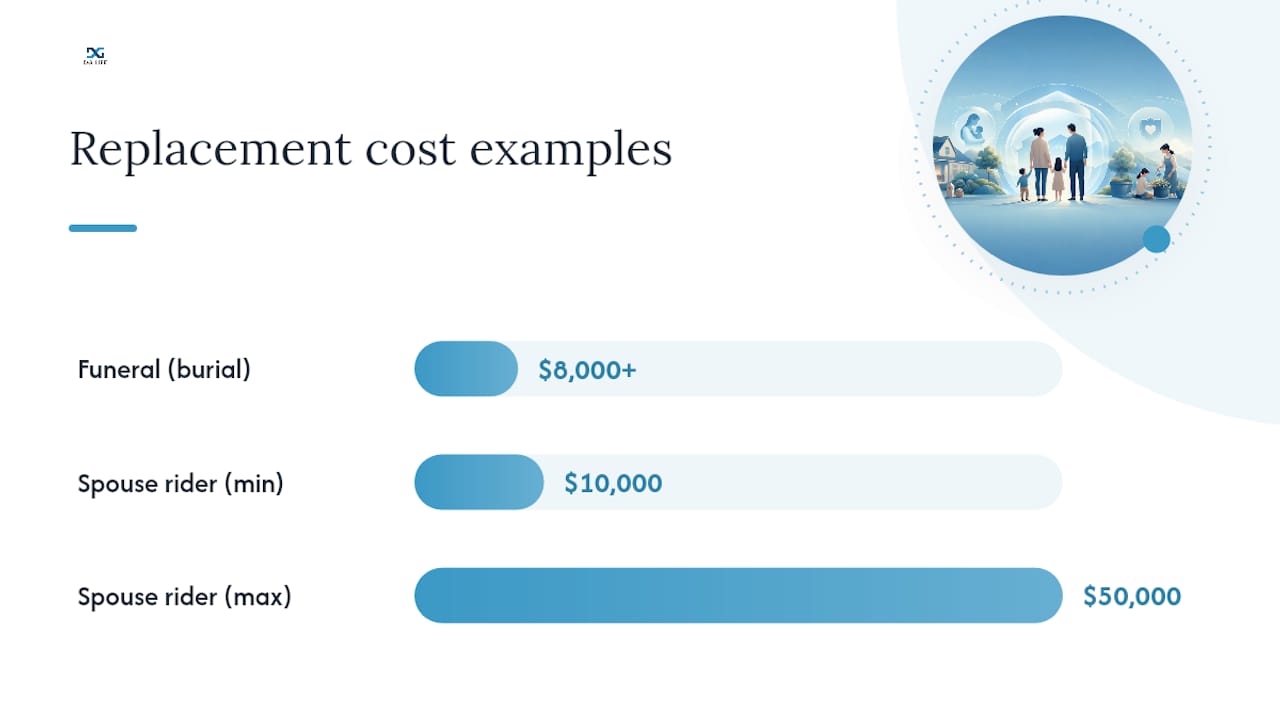
Funeral costs in the U.S. typically exceed $8,000 with burial, according to the National Funeral Directors Association. That is before childcare, mortgage payments, or a single college fund. Many families lean on a small spouse rider tacked onto a working partner's group policy at work, assuming it covers the gap. It rarely does. Those riders typically max out at $10,000 to $50,000, a fraction of what replacing a full-time parent actually costs.
Two Ways To Size Your Coverage (With Real Numbers)
You have two solid methods for landing on a coverage number, and you don't need a finance degree to use either one.
- The household-contribution method. Add up what you'd pay someone else to do your job. A one-child family might tally $2,000/month for full-time daycare, $400/month for housekeeping help, and $300/month for meal delivery or prep help. That's $2,700/month, or $32,400/year. Multiply by the years until your youngest turns 18, and you land somewhere near $400,000 to $500,000 for a family with a child under five. A two-child family with more transport, tutoring, and activity coordination often lands closer to $600,000 to $700,000. Some industry compilations estimate full household-contribution values for stay-at-home parents may range in the high hundreds of thousands of dollars annually depending on family size and region, according to NerdWallet's analysis.
- The future-earnings method. If you plan to return to paid work once your kids are older, estimate what you'd earn in that role and for how many years your family would need to bridge that gap in your absence. A former teacher earning $55,000/year who planned to return in eight years might justify roughly $440,000 in coverage tied to that projected income stream, layered on top of household-contribution needs.
Pro Tip: Match your term length to your youngest child's path to independence. A 20 to 25-year term aligned to your child-dependency horizon is usually more efficient than one long policy sized for peak need the whole way through. Consider laddering: a smaller policy that runs 25 years alongside a larger one that runs just 10 to 12, covering the highest-need years without paying for coverage you won't need later.
Term, Whole, Or Something With Living Benefits?
Term life insurance almost always gives you the most coverage per premium dollar, which matters because your need here is finite. You're replacing labor and cost for a set number of years, not insuring against a permanent obligation, so term is the natural fit for most stay-at-home parents. Compare the mechanics on our term versus whole life breakdown if you want the full picture.
Permanent policies, like whole life or indexed universal life, still have a place, but usually for estate or legacy planning rather than pure income replacement. If you're mainly covering childcare years, that expense is rarely justified.
Two features are worth prioritizing regardless of which chassis you pick:
- Living benefits. These riders let you access part of your death benefit while still alive if you're diagnosed with a critical, chronic, or terminal illness. For a stay-at-home parent who's also managing a family member's care or carries some health risk, this converts a future payout into cash you can use for medical bills or income replacement right now.
- No-exam underwriting. Skipping the paramedical exam speeds approval, sometimes to minutes rather than weeks, though it can come with a slightly higher premium or a lower face-amount cap. For many healthy applicants, it's a fair trade for speed.
How Underwriters Look At A Non-Working Applicant
Carriers can't verify your income the way they can a working spouse's, so they lean on a different anchor: your partner's coverage. Most insurers cap a stay-at-home parent's policy at a portion of the working spouse's face amount, commonly between half and the full amount, reflecting insurable interest considerations, as noted in underwriting summaries.
Expect the application to ask for:
- Your working spouse's income and existing policy details
- Evidence of your intent to return to work, if that applies to your situation
- Standard medical history, whether you choose paramedical exam underwriting or a no-exam product
If you want coverage above the typical cap, documented pre-children income history or a clear future-earnings case can help you get there, per underwriting practice notes.
The timeline runs quote, application, underwriting, then delivery, often just days for no-exam products and a few weeks for fully underwritten policies.
Pro Tip: If an agent tries to sell you a small employer spouse rider as your only solution, treat that as a red flag. Those riders are cheap because the coverage is thin, not because they're a good deal.
What Coverage Actually Costs
A healthy, non-smoking parent in their mid-thirties can often find a 20-year, $500,000 term policy for a modest monthly premium, with $750,000 in coverage frequently costing a few dozen dollars per month depending on health class, according to sample premium data from insurance brokers. This amount may be comparable to typical daycare weekly costs in many areas.
Price moves on a handful of levers:
- Age at application, since younger applicants lock in lower rates for the full term
- Smoker status, which can roughly double premiums
- Term length, with 20 and 25-year terms costing more than 10-year terms but locking in a rate through the highest-need years
- Health class, determined by build, family history, and any existing conditions
- No-exam loading, a modest premium bumps some carriers apply in exchange for skipping the exam
Your Shopping Checklist Before You Buy
- Set your coverage target using the household-contribution or future-earnings method, whichever fits your plans.
- Pick a term length matched to your youngest child's age, 20 to 25 years for most families.
- Request quotes for both fully underwritten and no-exam living-benefits policies to compare cost and speed.
- Confirm the policy's conversion and renewal terms before you sign.
- Name and review your beneficiaries, including contingent beneficiaries, using a resource like our beneficiary selection guide if you're unsure how to structure it.
When you talk to a broker, ask directly about coverage caps for non-working applicants, contestability periods, real claim examples, and the financial strength ratings of the carriers they represent.
Why I Push Back On "Wait Until You Return To Work"
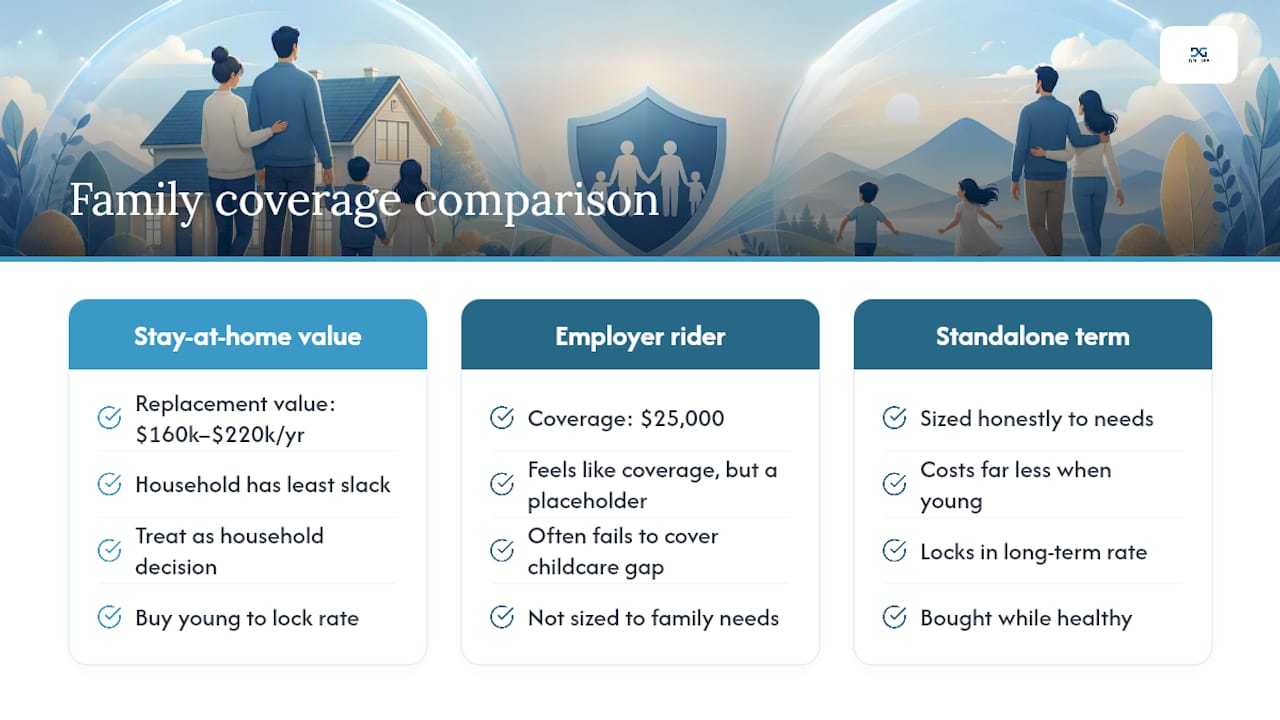
A lot of financial advice tells stay-at-home parents to hold off on their own policy until they're earning again, treating the working spouse's coverage as sufficient for the whole family. I think that advice gets the risk backwards. The household-contribution math shows a stay-at-home parent's labor is often worth $160,000 to $220,000 a year in replacement terms, and that's the exact window where a family has the least slack to absorb a sudden gap, whether it's daycare, a nanny, or a parent scrambling to cut work hours to cover the difference.
The other misconception I see constantly: treating a $25,000 employer rider as "handled." It's not handled. It's a placeholder that feels like coverage until you actually run the numbers against real childcare costs in your area. Standalone term, sized honestly and bought while you're young and healthy, costs far less than most people assume, and it locks in a rate you'll be glad you grabbed once you're a decade older and shopping again. The families who get this right treat coverage as a household decision, not an income decision.
— Dev
Get A Quote Built Around What Your Family Actually Needs
Some independent brokerages compare pricing and underwriting across multiple A-rated carriers, helping you get a policy that fits a stay-at-home parent's situation rather than relying on a single insurer's offering.

If living benefits matter to your family, whether because of a health history or simply wanting flexibility if a serious diagnosis hits, our Living Benefits Guide walks through how those riders work and what they cost. Many of our carrier partners also offer no-exam underwriting, so approval can happen in minutes rather than weeks. Households juggling elder care alongside childcare should also look at adult day care benefits when tallying replacement costs. Ready to see real numbers for your family? Request a personalized quote through Dglifegroup and we'll match you with carriers suited to your health profile and coverage goals.
Sources
- Child Care Aware — price landscape
- National Funeral Directors Association — statistics
- NerdWallet — Why stay-at-home parents need life insurance
This article is general information, not a substitute for advice from a qualified financial advisor. Consult a qualified financial professional about your own circumstances before acting on anything here.
FAQ
What Is The Paradox Of Stay-At-Home Parents?
The paradox is that stay-at-home parents perform labor worth a high amount in replacement value, yet because that labor generates no paycheck, families often skip insuring it entirely.
How Can A Stay-At-Home Mom Make $2,000 A Month?
Common paths include part-time remote work, freelance services, childcare swaps that free up paid hours, or seasonal work timed around school schedules, though income varies widely by skill set and location.
What Benefits Can I Claim If I Am A Stay-At-Home Mom?
Benefit eligibility depends on household income, state programs, and family size; check with your state's health and human services office for programs like Medicaid, CHIP, or childcare subsidies you may qualify for.
Why Do Stay-At-Home Moms Need A Break?
Constant childcare and household management without paid help or scheduled relief leads to burnout, which is one more reason families budget for backup childcare or household help, costs that also belong in your life insurance coverage math.
Do Stay-At-Home Parents Need Life Insurance If They Have No Income?
Yes. Coverage isn't based on income; it's based on the cost of replacing childcare, housekeeping, and household management if that parent were gone.