
Universal life insurance is permanent coverage built around a flexible premium and a cash-value account, and it works best for people who want a lifelong death benefit and the option to tap savings later, but who will actually watch how the policy performs. It is not a "set it and forget it" product. The insurance regulators (NAIC) and the IRS govern how these policies are built and taxed, and firms like Dglifegroup exist specifically to help buyers read past the marketing and into the guarantees.
TL;DR:
- Underfunding risks increase as interest crediting rates fall and mortality costs rise, especially if premiums are paid only at the minimum required level.
- The guaranteed interest rate and reserve numbers are more reliable indicators of policy stability than illustrated projections, which can be overly optimistic.
- Costs are generally lower than whole life but depend heavily on proper funding and regular review; underfunding can lead to policy lapses and higher long-term expenses.
- Cash value withdrawals and loans are tax-deferred or tax-free up to basis, but unpaid loans reduce death benefits, and surrendering can trigger taxable gains.
- Working with an independent broker to compare guaranteed and illustrated figures across multiple carriers improves the chances of choosing a durable, well-structured UL policy.
Table of Contents
- What Is Universal Life Insurance and How Does It Work?
- How Does Universal Life Insurance Work Mechanically?
- What Are the Main Types of Universal Life Insurance?
- Universal Life Insurance vs Term Insurance and Whole Life
- Benefits and Drawbacks of Universal Life Insurance
- What Do Universal Life Insurance Costs and Funding Risks Look Like?
- How Are Loans, Withdrawals, and Taxes Handled in Universal Life Insurance?
- Is Universal Life Insurance Worth It for You?
- What Are the Next Steps to Buying Universal Life Insurance?
- A Broker's View on Universal Life Insurance
- Get a Universal Life Insurance Quote and Comparison
- Sources
- FAQ
What Is Universal Life Insurance and How Does It Work?
Universal life insurance, often shortened to UL, is a type of permanent life insurance. Unlike term coverage, which expires after a set number of years, UL is designed to stay in force for your entire life, provided you fund it correctly. It pairs a death benefit with a cash-value account that grows based on interest crediting, index performance, or investment returns, depending on which UL variant you own.
The distinguishing feature is flexibility. You can raise or lower your premium within contract limits, and in most designs, you can adjust the death benefit as your needs change. That flexibility is also the source of most UL complaints. Universal life insurance requires the policyowner to actively manage funding, because the cash value that keeps the policy alive is not guaranteed to grow the way an early illustration suggested.
Here's what tends to trip people up: understanding universal life insurance means separating what the contract guarantees from what a sales illustration merely projects. Those are two very different numbers, and confusing them is how policies end up underfunded decades after purchase.
- Permanent coverage with flexible premiums and an adjustable death benefit
- Cash value that can be accessed through loans or withdrawals
- Four major product types, each allocating risk differently
- Real lapse risk if the policy is underfunded for too long
On cost, whole life premiums are typically significantly higher than comparable universal life premiums, because whole life bakes in guarantees that UL leaves optional. That gap is the entire trade-off in one sentence: UL costs less upfront because you, not the insurer, absorb more of the funding risk.
How Does Universal Life Insurance Work Mechanically?
Every UL policy runs on what amounts to a monthly account loop. Your premium payment lands in the policy's account value. From there, the insurer deducts the cost of insurance (COI), administrative charges, and any rider fees, then credits interest on what remains, subject to a guaranteed minimum rate stated in the contract. What's left carries forward into the next period, and the cycle repeats.

That loop explains why two numbers on your annual statement rarely match: policy value and net cash surrender value. Policy value is the raw account balance. Net cash surrender value is what you would actually receive if you canceled the policy today, after any surrender charges are subtracted. Investopedia's breakdown of UL mechanics makes clear that these two figures diverge especially in the early years, when surrender charges are steepest.
The cost of insurance is the part buyers underestimate. COI rises as you age, because the insurer's mortality risk increases every year you're alive. In your 30s and 40s, COI might be a small fraction of your premium. By your 70s and 80s, it can consume a much larger share of the account, sometimes fast enough to drain cash value if the policy hasn't been funded ahead of that curve.
This is exactly why the guaranteed column matters more than the illustrated one. Regulatory model rules require insurers to show both guaranteed and nonguaranteed projections side by side, and to define minimum cash surrender values and reserve requirements in the contract itself, according to the NAIC Universal Life Insurance Model Regulation. Many states also require insurers to send annual reports and a written notice, often 30 days, before a policy actually lapses for nonpayment. Read those reports. They're your earliest warning system.
What Are the Main Types of Universal Life Insurance?
Four major UL variants exist, and each one allocates the crediting risk differently between you and the insurer. Knowing which one you're being shown changes how you should read the illustration.
- Traditional (fixed-interest) UL: the carrier declares an interest rate periodically, subject to a contractual minimum. This is the most predictable UL variant, though even here, declared rates can drop in a prolonged low-rate environment.
- Indexed universal life (IUL): cash value crediting is linked to an external index, like the S&P 500, but with caps limiting your upside and floors limiting your downside. IUL illustrations can look appealing, which is exactly why regulators tightened the assumptions insurers are allowed to project, through updates like AG49-B.
- Variable universal life (VUL): premiums are invested in subaccounts similar to mutual funds, exposing your cash value to full market risk. VUL carries additional securities regulation because you're taking on direct investment exposure, not just a crediting formula.
- Guaranteed universal life (GUL): minimal cash-value accumulation in exchange for a stable, often lifetime, death benefit at a lower relative cost. GUL behaves more like permanent term coverage than a savings vehicle, according to Forbes Advisor's comparison of term and whole life features.
Our IUL Guide breaks down the caps, participation rates, and crediting methods behind indexed universal life in more detail if that's the variant you're comparing.
Universal Life Insurance vs Term Insurance and Whole Life
The comparison most buyers actually need isn't UL versus term. Term insurance is temporary by design and has no cash value at all, so it solves a different problem: income replacement for a defined window, usually 10 to 30 years. The real decision, once you've settled on wanting permanent coverage, is universal life insurance vs whole life insurance.
Whole life trades flexibility for certainty. Premiums are fixed, cash-value growth is guaranteed at a contractual minimum, and the insurer absorbs the funding risk. Universal life flips that arrangement: you get premium flexibility and often a lower entry cost, but you absorb more of the risk if crediting rates fall or if you skip payments during a rough financial stretch.
Neither structure is objectively better. A retiree who wants zero ongoing decisions might prefer whole life's predictability. A younger buyer who wants lifetime coverage but expects income to fluctuate might value UL's flexibility more. If you want a side-by-side breakdown of how permanent life insurance products differ on guarantees and cost structure, that comparison is worth reading before you commit to either.
Benefits and Drawbacks of Universal Life Insurance
The benefits of universal life insurance are real, but they come with conditions attached.
What UL does well:
- Provides lifetime death benefit coverage, not a coverage window that expires
- Lets you raise, lower, or skip premiums within contract limits as your income changes
- Builds cash value with tax-deferred growth
- Allows policy loans against the cash value for expenses or opportunities
- Can be paired with living-benefit riders that let you access part of the death benefit while still alive, during a qualifying illness
Where UL creates risk:
- Underfunding is the single biggest cause of policy failure, because low early payments don't build enough cushion for rising COI later
- Cash-value crediting on IUL and VUL is not guaranteed and can underperform illustrations
- Fees and charges (COI, admin, riders, surrender charges) compound over decades
- The mechanics are genuinely more complex than term or whole life, which makes shopping harder
Pro Tip: Always ask for the guaranteed column, not just the illustrated one, and request a conservative scenario that assumes minimum crediting rates. If the policy still holds up under that scenario, you're looking at a design built to last, not one built to sell.
What Do Universal Life Insurance Costs and Funding Risks Look Like?
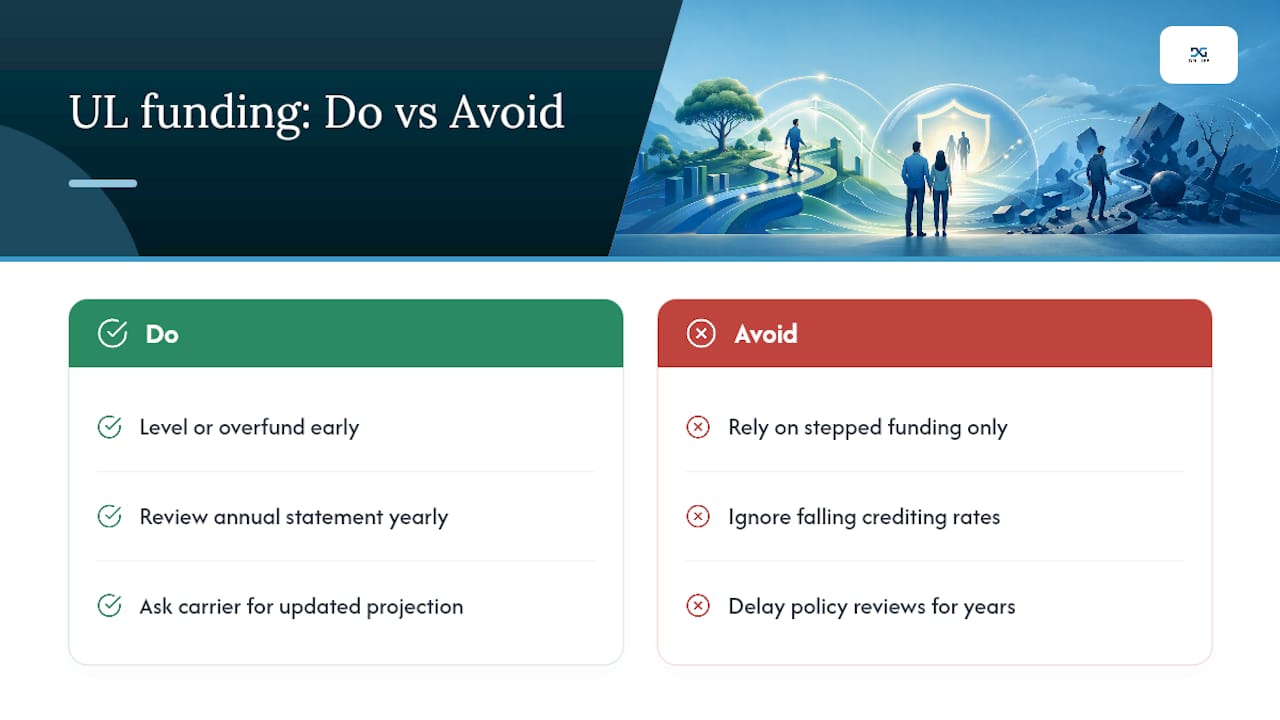
How you fund a UL policy matters as much as how much you pay. Stepped funding, paying only the minimum required to keep the policy active, keeps early costs low but leaves almost no cushion against rising COI later. Level or overfunding, paying more than the minimum in the early years, builds cash value that can absorb cost increases decades down the line without requiring a sudden premium jump.
On raw cost, UL premiums are generally lower than whole life premiums for comparable coverage, precisely because whole life guarantees cost more to fund. But that comparison assumes the UL policy is properly funded. Underfunded, a UL policy can end up costing far more over its lifetime, either through a forced premium increase or an outright lapse.
Falling interest-crediting rates are the quiet killer here. A policy that looked fully funded when interest rates were higher can fall behind years later if crediting drops and COI keeps climbing. That's how policyowners in their 70s and 80s suddenly receive a lapse notice on a policy they thought was secure. If your policy has already lapsed, reinstatement options exist, but they're rarely as clean as keeping the policy funded in the first place.
The practical fix is simple: review your policy's annual statement every year, not every decade, and ask your carrier or broker for an updated projection whenever crediting rates shift materially.
How Are Loans, Withdrawals, and Taxes Handled in Universal Life Insurance?
Three distinct actions exist inside a UL policy, and the tax and death-benefit consequences differ for each. A policy loan is generally tax-free, but any unpaid balance, plus accrued interest, reduces the death benefit your beneficiaries eventually receive. A withdrawal pulls cash directly from the account value and is typically tax-free up to your basis (what you've paid in premiums), but amounts above that basis can be taxable as ordinary income, per Investopedia's explanation of UL tax treatment.
Surrendering the policy entirely is the most consequential move. You receive the net cash surrender value, which is the account value minus any remaining surrender charges, and any gain above your premium basis is generally taxable.
Given how easily these distributions interact with retirement income planning, it's worth talking to a tax professional before taking a large loan or surrender, particularly if you're also weighing other income sources like a pension lump sum against an annuity or considering a reverse mortgage as part of a broader retirement funding strategy.
Is Universal Life Insurance Worth It for You?
Universal life insurance tends to fit people who want lifetime coverage, have some tolerance for monitoring their policy, and want the option to access cash value later, whether for retirement supplement, emergencies, or a living-benefit event. If you want zero ongoing decisions and guaranteed premiums for life, whole life or a guaranteed UL design usually fits better. If you only need coverage for a fixed period, term insurance is cheaper and simpler.
Before buying, run through this checklist:
- Can you comfortably fund the policy above the bare minimum for at least the first decade?
- Are you willing to review annual statements and respond to funding notices?
- Do you need cash-value access, or would GUL's lower-cost, lifetime death-benefit design serve you better?
- Does your situation involve estate planning or tax considerations that favor UL's flexibility?
- Has your agent shown you the guaranteed column alongside the illustrated one?
Ask specifically for a no-lapse guarantee rider if lifetime certainty matters to you, and request the full breakdown of rider costs and fees before signing anything.
What Are the Next Steps to Buying Universal Life Insurance?
Before you request quotes, gather three things: the death benefit amount you actually need, an honest summary of your health history, and a target premium you can sustain for years, not just this year. Underwriters weigh health history heavily, and buyers with conditions sometimes assume they'll be denied when no-exam or condition-specific options exist.
When illustrations arrive, compare the guaranteed column across every carrier before you even glance at the projected one. Ask which riders make sense, living benefits, no-lapse guarantees, and which are just added cost. Because UL designs vary so much by carrier, working with an independent broker who can pull quotes across multiple A-rated insurers, rather than a captive agent tied to one company, typically surfaces better pricing and design fit.
A Broker's View on Universal Life Insurance
Universal life insurance gets a bad reputation it partly deserves and partly doesn't. Underfunded IUL policies sold on rosy illustrations have burned enough retirees that the skepticism is earned. But the fix isn't avoiding UL. It's insisting on the guaranteed column before you buy.
Living-benefit riders, which let a client access part of the death benefit while still alive during a critical illness, can change the entire value proposition of permanent coverage. Pairing that access with no-medical-exam options and a network of multiple A-rated carriers can help clients get properly structured coverage more efficiently, without gambling on an optimistic illustration.
The honest read is this: universal life insurance is worth it for the right buyer, but only if someone forces the guaranteed numbers onto the table first.
— Dev
Get a Universal Life Insurance Quote and Comparison
An independent broker can offer side-by-side comparisons across multiple A-rated insurers, so you're never stuck with one company's crediting assumptions or one company's rider lineup. That matters most with universal life, where the guaranteed column can vary meaningfully from carrier to carrier.

We work as an independent broker, which means we earn a commission from the carrier you choose, not from steering you toward any one product. Our job is to show you the guaranteed-column numbers next to the illustrated ones, explain living-benefit riders in plain terms, and flag no-exam options if your health history makes traditional underwriting a hassle. If you're ready to see how different UL designs actually compare for your situation, get a side-by-side quote comparison and we'll walk you through the guarantees before you sign anything.
This article is general information, not a substitute for advice from a qualified financial advisor. Consult a qualified financial professional about your own circumstances before acting on anything here.
Sources
- Whole Life vs. Universal Life Insurance – Forbes Advisor
- Universal vs. Whole Life Insurance – MoneyGeek
- UNIVERSAL LIFE INSURANCE MODEL REGULATION (NAIC Model 585)
- What Is Universal Life (UL) Insurance? – Investopedia
FAQ
What Is the Downside to Universal Life Insurance?
The biggest downside is underfunding risk. If you pay only the minimum required premium and crediting rates fall or costs of insurance rise, the policy can lapse decades after purchase, sometimes right when you need coverage most. Non-guaranteed crediting on IUL and VUL variants adds another layer of uncertainty compared to whole life's fixed guarantees.
What Does Dave Ramsey Say About Universal Life Insurance?
Dave Ramsey generally advises against universal life insurance, favoring term life paired with separate investing. His core objection mirrors the industry's own caution: UL's non-guaranteed crediting and fee structure can underperform simpler alternatives if the policy isn't funded conservatively and monitored closely.
Can I Cash Out My Universal Life Insurance Policy?
Yes. You can surrender the policy for its net cash surrender value, which is the account value minus any remaining surrender charges. Any gain above what you've paid in premiums is generally taxable as ordinary income, so it's worth confirming your basis before you surrender.
What Is the Average Monthly Cost of Universal Life Insurance?
Cost varies widely by age, health, death benefit, and which UL variant you choose, so there's no single reliable average to quote. Universal life premiums are typically lower than comparable whole life premiums because whole life bundles in guarantees UL leaves optional; getting an instant quote comparison across multiple carriers is the most accurate way to see real numbers for your situation.