
Choose whole life if you want a fixed premium, a guaranteed death benefit, and a policy you can largely leave alone. Choose universal life if you want a lower starting cost and flexible premiums but are prepared to check in on the policy regularly. Both build cash value over time, but whole life trades higher cost for certainty, while universal life trades lower cost for a monitoring obligation that lapses can punish severely.
TL;DR:
- Universal life insurance offers lower initial premiums but requires active monitoring to prevent policy lapses due to flexible payments and interest rate fluctuations.
- Whole life insurance has higher premiums but guarantees fixed costs, death benefit, and minimum cash value growth without the need for ongoing oversight.
- Cash value growth in universal life depends on interest rates or market performance, making it more vulnerable to rate changes, while whole life relies on guaranteed growth and dividends.
- Surrender charges are front-loaded in both policies, with whole life typically having slower early growth, making early cancellation costly and discouraging frequent changes.
- Working with an independent broker can help find tailored quotes across multiple carriers, assessing factors like dividend potential, lapse risk, and policy riders based on your specific needs.
Table of Contents
- Universal Life vs. Whole Life: What They Actually Are
- Whole Life vs. Universal Life: A Side-by-Side Look
- Pros, Cons, and Who Each Policy Actually Fits
- How Cash Value, Loans, and Living Benefits Work
- How to Choose Between Whole Life and Universal Life
- Underwriting: How the Application Process Differs
- Real-World Scenarios: Where Each Policy Wins
- Interest Rates and Universal Life Performance
- Surrender Charges: The Cost of Backing Out Early
- What DG Life Group Brings to This Decision
- Get Help Comparing Whole Life and Universal Life Quotes
- Sources
- FAQ
Universal Life vs. Whole Life: What They Actually Are
Both are permanent life insurance policies, meaning coverage lasts your entire life as long as premiums stay current, and both accumulate cash value you can borrow against. The mechanics behind that cash value are where they split apart.
Whole life insurance locks in a fixed premium and a guaranteed death benefit for the life of the policy, along with guaranteed minimum cash-value growth. Some carriers also pay dividends on top of that guaranteed growth, though dividends are never contractually promised. Universal life insurance works differently: premiums are flexible, the death benefit can be adjusted up or down within insurer limits, and cash value grows through interest credits tied to a fixed rate, a market index, or (with variable UL) actual investment performance, according to Northwestern Mutual.
Every premium dollar in either policy type splits two ways:
- A portion covers the cost of insurance, the actual mortality charge for your coverage.
- The remainder funds cash-value accumulation, which grows tax deferred in both policy types.
That split explains why underfunding a universal life policy is so risky. Skip too many payments, and there may not be enough cash value left to cover the insurance cost.
Whole Life vs. Universal Life: A Side-by-Side Look
The clearest way to see the trade-off is to line up the two policies across the categories that actually drive a buying decision.
| Feature | Whole Life | Universal Life |
|---|---|---|
| Premium structure | Fixed, same amount for life | Flexible, can raise or lower within limits |
| Death benefit guarantee | Guaranteed for life | Adjustable, not always guaranteed if underfunded |
| Cash-value growth | Guaranteed minimum, possible dividends | Variable, tied to interest rate, index, or market |
| Cost | Higher upfront premium | Lower starting premium |
| Monitoring needed | Minimal | Ongoing, to avoid lapse |
| Dividend potential | Possible, non-guaranteed | Not applicable in most designs |
Whole life typically costs more per month than universal life for a $500,000 policy, with the cost difference increasing as the buyer's age at purchase rises, according to MoneyGeek's rate analysis. Younger buyers see a smaller gap, while older buyers see a wider one.
That lower starting cost on universal life is not free money. Because premiums are flexible, a policyholder can pay less than the amount needed to sustain the coverage, and if cash value drops too low, the policy can lapse entirely. Investopedia notes that universal life requires active monitoring for exactly this reason: variable cash-value growth combined with flexible premiums creates a lapse risk that fixed-premium whole life simply doesn't have. Whole life, by contrast, doesn't ask you to watch anything. The premium is set, the growth is guaranteed, and the death benefit is locked in from day one.
Pros, Cons, and Who Each Policy Actually Fits
Whole life's strength is predictability. You know the premium, the death benefit, and the minimum cash-value trajectory before you sign anything. The tradeoff is cost. You're paying more each month for that certainty, and you generally have less flexibility if your budget changes.
Universal life's strength is control. You can adjust premiums when money is tight, and some designs let you increase the death benefit later without new underwriting. The tradeoff is responsibility. You have to track cash value and interest performance or risk an unpleasant lapse notice years down the road.
Three buyer profiles tend to fall out of this naturally:
- The estate planner who wants certainty. Someone funding a trust or covering estate taxes usually needs a death benefit that cannot shrink. Whole life's guarantees fit that job better than a policy that can flex downward.
- The early-career buyer optimizing for cost and flexibility. Someone building coverage while income is still growing often prefers universal life's lower entry premium, with room to increase payments as earnings rise.
- The buyer who wants cash-value access with minimal hands-on management. This buyer leans whole life, since the guaranteed growth path doesn't require the same ongoing attention universal life does.
How Cash Value, Loans, and Living Benefits Work
Cash value in both policy types grows tax deferred, meaning you don't owe tax on the growth each year the way you might with a taxable brokerage account, a point FINRA makes clear in its guidance on permanent life insurance.
Once cash value builds, you generally have two ways to access it:
- Policy loans, which let you borrow against cash value without an immediate tax bill, but the loan balance reduces the death benefit until it's repaid.
- Withdrawals, which pull cash out directly and can trigger taxable income if you withdraw more than you've paid in premiums.
Forbes Advisor points out that both loans and withdrawals carry a real risk: if the policy lapses or is surrendered while a loan is outstanding, the unpaid balance can become taxable income all at once.
Living-benefit riders, sometimes called accelerated death benefit riders, let you access part of the death benefit while still alive if you're diagnosed with a qualifying critical, chronic, or terminal illness. These typically pay out tax-free funds you can use for medical costs or income replacement, and they're available on many whole life and universal life contracts alike.
Pro Tip: Before taking a policy loan, ask your carrier for an in-force illustration showing how the loan affects your death benefit and lapse date under a worst-case interest scenario, not just the current one.
How to Choose Between Whole Life and Universal Life
Start with five questions before you compare quotes:
- What's my monthly budget, and how likely is it to change in the next 5 to 10 years?
- Do I need a death benefit that's guaranteed, or can I tolerate some variability?
- Am I willing to review annual statements and adjust funding if cash value underperforms?
- Is this policy funding an estate plan, a business need, or personal income replacement?
- Would I rather pay more now for certainty, or less now with future oversight?
When you talk to an agent, ask directly about guaranteed versus non-guaranteed cash-value assumptions, the dividend history on any whole life policy you're considering, surrender charge schedules, and what triggers a lapse warning on universal life. If you already own a policy and are considering a switch, ask whether a 1035 exchange makes sense, since it can move cash value between contracts without an immediate tax hit when structured correctly.
From there, get actual quotes, model your funding scenario against a few interest rate assumptions, and compare the real numbers instead of general assumptions.
Underwriting: How the Application Process Differs
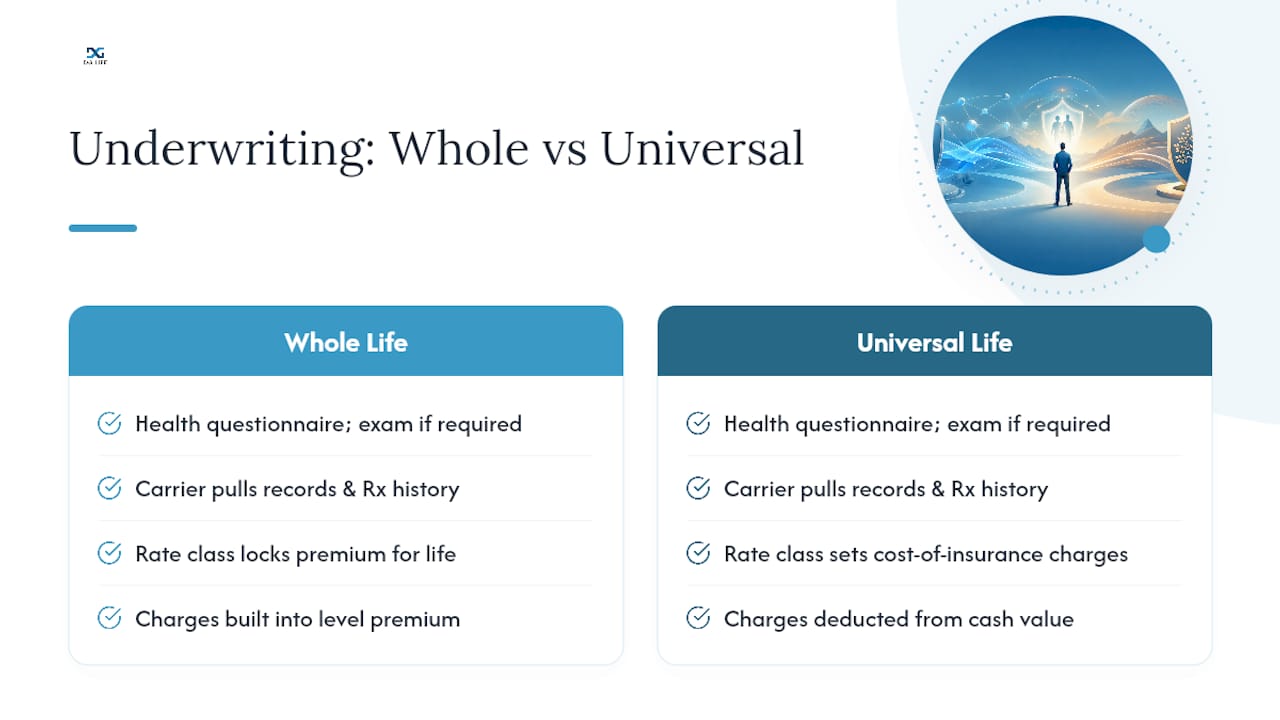
Underwriting for whole life and universal life looks similar on paper. Both typically require a health questionnaire, and depending on age and coverage amount, a medical exam with blood and urine samples. Carriers pull your medical records, prescription history, and sometimes a motor vehicle report before issuing a final rate class.
Where the two diverge is in how rate classes affect the policy going forward. On whole life, your underwriting class locks in your premium for life. Get a Preferred rating and that fixed rate never moves. On universal life, underwriting still sets your cost of insurance charges, but because those charges are deducted from cash value rather than baked into a level premium, a poor rate class can quietly erode your cash value faster than expected if you're not funding the policy generously.
No-exam options exist for both policy types now, typically for buyers seeking smaller face amounts or willing to accept a shorter look-back period on health history. These policies use algorithmic underwriting instead of lab work, trading a slightly higher premium for speed. That trade matters most for buyers managing a health condition or simply wanting coverage in place fast, and it's one reason no-exam universal life and whole life products have grown in the last several years.
Real-World Scenarios: Where Each Policy Wins
Picture a 45-year-old business owner who wants $750,000 in coverage to fund a buy-sell agreement with a partner. She needs certainty that the death benefit will be there no matter what happens to interest rates over the next 20 years. Whole life fits, because the buy-sell agreement depends on a number that cannot shrink.
Now picture a 29-year-old software engineer buying $500,000 in coverage right after a raise. His income is likely to keep climbing, and he'd rather pay less now and increase funding later. Universal life fits here, letting him start light and add more once his salary catches up, without needing to underwrite a brand-new policy.
A third scenario: a 58-year-old couple wants to leave $300,000 to their children and also wants access to living benefits in case a serious illness hits before either of them passes. Either policy type can carry a living-benefit rider, but because they're closer to retirement and want predictable growth, whole life's guaranteed cash-value path often makes more sense than betting on index performance this late in the planning window.
These aren't universal rules. They're patterns that show up again and again once you map priorities against how each policy actually behaves.
Interest Rates and Universal Life Performance
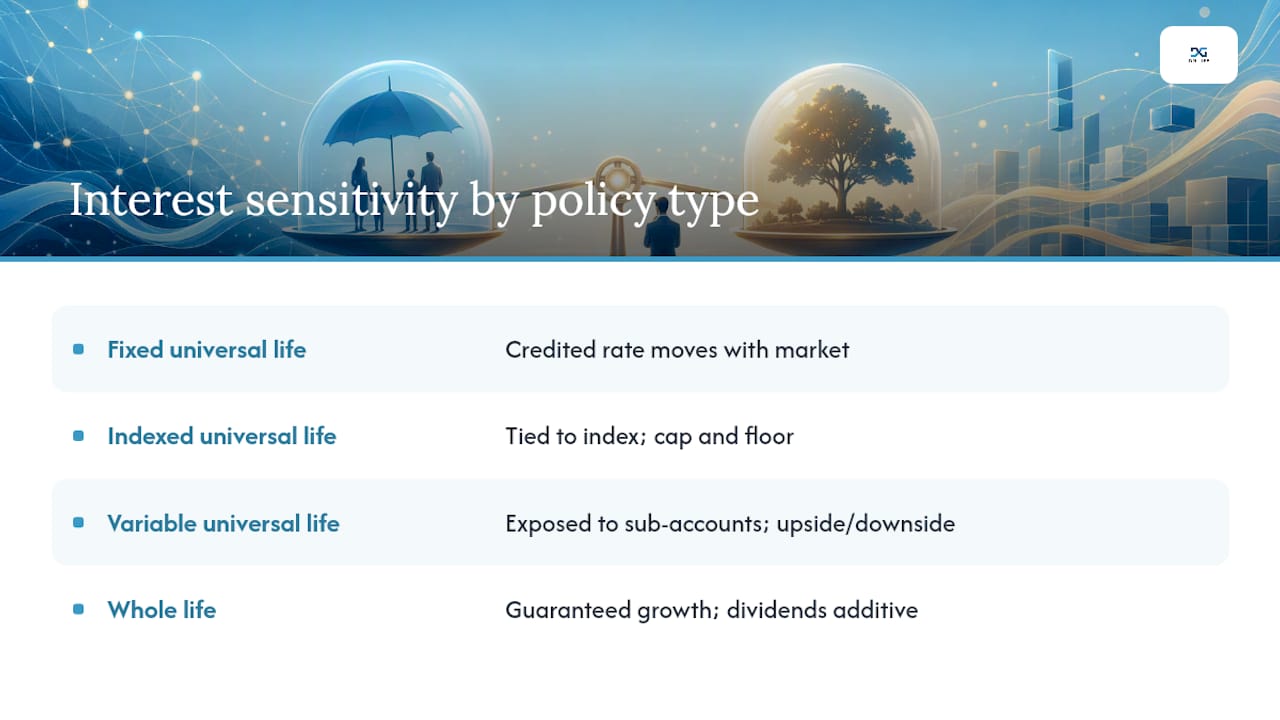
Universal life is far more sensitive to the interest rate environment than whole life, and that sensitivity is the single biggest reason policies bought decades ago have run into funding trouble. Fixed-rate universal life credits interest based on rates the carrier sets, which move with broader market rates. When rates fall for an extended stretch, as they did for much of the 2010s, cash-value growth can come in well below what the original policy illustration projected, leaving the policyholder to either raise premiums or watch the cash-value cushion shrink.
Indexed universal life ties growth to an index like the S&P 500, usually with a cap and a floor, so it doesn't crash with the market but also doesn't fully capture a bull run. Variable universal life goes further, exposing cash value directly to investment sub-accounts, which means real upside and real downside.
Whole life sidesteps this problem almost entirely. Its guaranteed growth rate doesn't move with the market, and dividends, when paid, are additive rather than load-bearing. That's precisely why whole life buyers accept a higher premium: they're paying for insulation from exactly this kind of rate risk. If you're leaning toward universal life, ask for an illustration run at a lower assumed rate, not just the current one, so you can see how the policy behaves if rates soften for a decade.
Surrender Charges: The Cost of Backing Out Early
Both policy types carry surrender charges if you cancel within the first several years, typically 10 to 15 years depending on the carrier and product. These charges exist because the insurer front-loads commission and administrative costs early in the contract, and canceling early means the company hasn't recovered them yet.
Whole life surrender charges tend to be baked into a more conservative cash-value curve in the early years, meaning your surrender value simply grows slowly at first rather than facing a separate, itemized penalty. Universal life often carries an explicit surrender charge schedule that declines each year, starting high in year one and phasing to zero by the end of the charge period, which typically runs 9 to 20 years depending on the product.
The practical impact is the same either way: canceling a permanent policy in year two or three usually returns far less cash than you've paid in. That's a strong argument for buying the right policy the first time rather than assuming you can switch cheaply later, and it's part of why the questions in the decision checklist above matter more than they might seem to at first glance.
What DG Life Group Brings to This Decision
Comparing whole life vs. universal life gets easier with access to more than one carrier's numbers. Dglifegroup works as an independent broker across 30+ A-rated carriers, which means the comparison you run isn't limited to a single company's products or pricing philosophy.
We also focus specifically on living-benefit riders and no-medical-exam options, two areas that matter most when health history or timing is part of the decision. For deeper research before you talk to anyone, our IUL guide breaks down indexed universal life mechanics in more detail than fits in a single comparison article.
— Dev
Get Help Comparing Whole Life and Universal Life Quotes
Reading about the differences is one thing. Seeing real numbers side by side, from carriers that actually fit your health profile and budget, is another. Dglifegroup gives you that second part directly: as an independent broker across 30+ A-rated carriers, we match you to pricing based on your specific situation, not a single insurer's product line, and premiums cost the same whether you buy through us or go direct.

For readers weighing whole life against universal life, our life insurance pricing page shows current monthly ranges for both policy types, along with term and final expense options if your priorities shift once you see the numbers. No-medical-exam applications are available for buyers who want speed or have a health condition that complicates traditional underwriting. After you request a quote, expect a short conversation about your goals and budget, followed by carrier matching and tailored pricing, often with coverage confirmed within minutes rather than weeks.
Sources
This comparison draws on MoneyGeek's rate analysis for cost data, Investopedia's guidance on monitoring and lapse risk, Northwestern Mutual's explanation of permanent policy mechanics, and Forbes Advisor's breakdown of loan and withdrawal tax consequences. For carrier-by-carrier premium modeling, see Dglifegroup's comparison tables and cost breakdown guide.
This article is general information, not a substitute for advice from a qualified financial advisor. Consult a qualified financial professional about your own circumstances before acting on anything here.
- Universal vs. Whole Life Insurance: Differences, Pros & Cons | MoneyGeek
- Universal Life Insurance vs. Whole Life | Investopedia
- Whole life vs universal life | Forbes Advisor
FAQ
Is Universal Life Cheaper Than Whole Life?
Yes, universal life typically starts with a lower monthly premium than whole life for the same coverage amount. MoneyGeek's analysis found whole life costs $167 to $543 more per month than universal life for a $500,000 policy, depending on age.
Can Universal Life Insurance Lapse?
Yes, universal life can lapse if flexible premiums aren't enough to cover the cost of insurance and cash value runs out. This is why Investopedia recommends active, ongoing monitoring for universal life policies in a way whole life doesn't require.
Does Whole Life Insurance Pay Dividends?
Some whole life policies pay dividends, but they're never guaranteed and vary by carrier and policy performance. Dividends sit on top of the policy's already guaranteed minimum cash-value growth, according to Northwestern Mutual.
What Happens if I Take a Loan Against My Policy?
Policy loans reduce your death benefit by the outstanding loan balance until it's repaid, and they can trigger a tax bill if the policy lapses or is surrendered while the loan is unpaid. Forbes Advisor covers this risk in detail for both whole and universal life contracts.
How Much Does a Policy Through DG Life Group Cost?
Whole life policies typically run $150 to $450 per month, while universal life and IUL policies run $200 to $600 per month, based on age, health, and coverage amount. Exact pricing depends on your quote and current pricing details. Exact pricing depends on your quote, available on the life insurance pricing page.